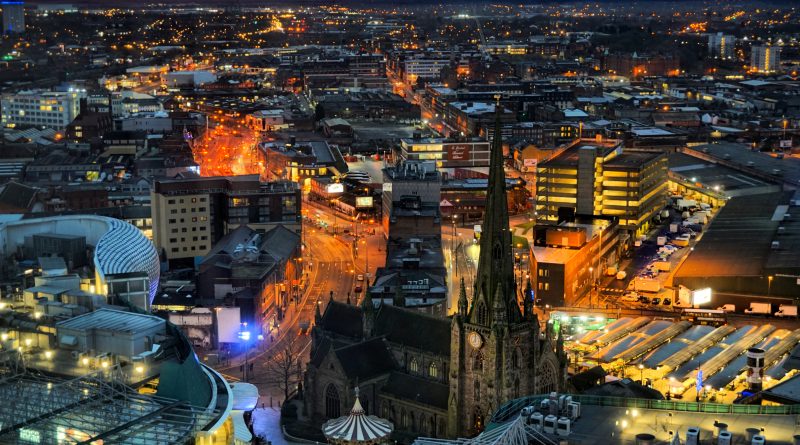
Birmingham’s £11bn regeneration vehicle signals a major urban shift
Subscribe to our free newsletter today to keep up to date with the latest construction and civil engineering news.
Birmingham is preparing to launch one of the largest urban regeneration programs seen in the UK outside London after government approval was granted for the Birmingham East Mayoral Development Corporation (MDC), a new body expected to oversee £11bn worth of investment across the city.
The corporation has been designed to accelerate development by consolidating powers tied to planning, land acquisition and brownfield remediation, giving regional leaders greater control over how large projects move from proposal to construction. Officials believe the MDC could eventually support the creation of 50,000 homes and 20,000 jobs across Birmingham’s eastern corridor and city center.
Its scale immediately places it among the most ambitious regeneration vehicles established in modern British urban policy, drawing comparisons with the development structures used to deliver the post-2012 Olympic transformation in east London. Yet Birmingham’s strategy also reflects a broader national trend, with regional authorities increasingly seeking more direct powers to unlock stalled housing, infrastructure and commercial projects.
At the center of the initiative sits Birmingham City Football Club’s proposed Sports Quarter in Bordesley Green, a project that has quickly evolved from a football stadium plan into a wider economic development strategy.
Birmingham is using planning reform and sports investment to accelerate regeneration
The Sports Quarter has become the most publicly visible component of the MDC’s ambitions. Birmingham City FC announced in 2024 that it had acquired a vacant 48-acre site in east Birmingham, later unveiling plans for a new stadium development known as The Powerhouse.
The wider proposal includes a training complex, a women’s stadium, entertainment facilities and mixed-use housing. While football remains the anchor, the broader intention is to create a long-term commercial and residential district capable of attracting investment well beyond matchday activity.
That distinction matters. Across the UK and Europe, sports-led regeneration has become increasingly tied to wider urban renewal programs rather than isolated stadium construction. Clubs and local authorities are attempting to use sports infrastructure as a catalyst for transport improvements, commercial development and residential growth.
The Birmingham East MDC has been specifically structured to reduce many of the delays that typically slow major regeneration projects. According to West Midlands Mayor Richard Parker, the body will have powers linked to land assembly, planning coordination and site remediation, all intended to shorten development timelines and improve investor confidence.
The emphasis on brownfield remediation is particularly important in Birmingham, where former industrial land often requires substantial preparation before construction can begin. By centralizing those processes, the corporation aims to reduce administrative fragmentation that has historically slowed development across large urban sites.
The approach also reflects increasing pressure on regional authorities to demonstrate delivery. Large regeneration schemes frequently struggle with overlapping jurisdictions, inconsistent planning processes and infrastructure funding gaps. The MDC model attempts to consolidate decision-making into a single delivery structure with direct political backing.
The £11bn pipeline stretches far beyond the new football stadium
While the Sports Quarter has attracted national attention, the MDC’s remit stretches across several of Birmingham’s most strategically significant development zones.
Among the largest projects is the proposed £4bn Birmingham Knowledge Quarter, intended to strengthen links between research institutions, advanced industries and commercial development. City leaders view the project as central to Birmingham’s attempts to expand higher-value sectors tied to technology, science and innovation.
The corporation will also support the long-running Smithfield redevelopment adjacent to the Bullring. Estimated at around £2bn, the scheme has been positioned as a major mixed-use destination incorporating housing, retail, hospitality and public space.
Digbeth forms another critical part of the strategy. The district has steadily developed a reputation as Birmingham’s creative and cultural hub, attracting independent businesses, media companies and creative industries. Regional leaders hope regeneration support can accelerate commercial growth while improving transport connectivity ahead of HS2 infrastructure expansion.
The arrival of HS2’s Curzon Street Station remains one of the most significant long-term economic variables shaping Birmingham’s development outlook. Alongside the adjoining Central Heart site, the station is expected to reshape investment patterns across the eastern side of the city center.
Together, these projects create a regeneration zone covering an area larger than 600 football pitches. The concentration of housing, transport and commercial development reflects a deliberate effort to create interconnected growth rather than isolated construction projects.
The economic implications are potentially substantial. Birmingham has spent years attempting to reposition itself as a national center for professional services, advanced manufacturing, digital industries and higher education. Infrastructure-led regeneration is increasingly being framed as the mechanism capable of supporting that transition.
Birmingham’s leaders are framing regeneration around jobs, skills and inclusion
Political leaders have also emphasized the social dimension of the MDC, particularly in east Birmingham where deprivation levels remain among the highest in the UK.
Joanne Roney, managing director of Birmingham City Council, has highlighted the importance of linking regeneration directly to employment and training opportunities for local communities. That includes discussions around skills funding and potential apprenticeship flexibility linked to incoming development projects.
This focus reflects a growing recognition across UK regeneration policy that physical redevelopment alone does not automatically improve economic outcomes for existing residents. Questions around local hiring, affordability and long-term inclusion increasingly shape public support for large infrastructure programs.
The challenge for Birmingham will be balancing investment speed with community integration. Regeneration schemes of this scale often generate tension around displacement, rising property costs and unequal economic benefits.
There are also practical delivery risks. Large mixed-use developments remain highly exposed to inflation, construction costs and broader economic uncertainty. Securing long-term private investment at the scale envisioned by the MDC will require sustained market confidence over many years.
Still, the approval of the Birmingham East MDC signals a significant shift in how regional growth may increasingly be managed in the UK. Rather than relying solely on fragmented council-led development, authorities are moving toward centralized regeneration vehicles with broader powers and closer integration between transport, housing and economic policy.
For Birmingham, the coming decade will determine whether that model can successfully translate political ambition into large-scale urban transformation. If it does, the city could emerge as one of the clearest examples of how regional Britain is attempting to redefine itself through infrastructure, housing and investment-led growth.
Source