design build facades makes Britain’s high-rise buildings safer by putting fire protection and accountability first
design build facades is a leading specialist in design and build overcladding, dedicated to delivering high-quality external refurbishment solutions. With a proven track record of executing some of the UK’s most technically challenging overcladding projects, the company showcases unmatched expertise in insulated aluminium rainscreen systems. In fact, its installations continue to perform flawlessly after more than 30 years, with minimal maintenance required. Pete Hillyard, Managing Director, provides an overview of design build facades’ history and services, with a particular emphasis on its commitment to fire safety.
“With a team of 30 employees, mainly with backgrounds in building, we are a small to medium-sized business,” Pete begins. “Many of us have been working together for nearly 35 years, and we have maintained long-standing relationships with our supply chain partners as well. Our specialty lies in the design and construction of facades for high-rise buildings, particularly those dating back to the 1960s, where we create new envelopes for them. This is known as overcladding in our industry, a field that started evolving in the late 1980s, and we have been specialising in it ever since. For the first 12 years, we were working for a firm called Allscot before going on to establish our own business, design build facades.”
At present, design build facades operates exclusively under pure non-prescriptive design and build contracts, a highly specialised approach. Pete explains the reasoning behind this strategy. “In the early 1980s, the first person I worked for was a pure design builder, which means he was coming up with the designs himself. Over time, I realized the importance of establishing a coherent design-build process.
“In the 1990s, we took on a few projects where the design was created by a consultant based on the system they had selected, which was then put out to tender, normally under the guise of a design-build inquiry. Unfortunately, the process often left the system supplier and consultant absolved of responsibility, with everything hived off to a main contractor or to a specialist. This was a hybrid design build approach that resulted in numerous complications, disconnects, and inefficiencies. Therefore, in the early 1990s, I decided that we would only be interested in genuine design-build work where we could manage every aspect from the outset – pure design and build. This way, we can employ effective systems and collaborate with numerous consultants while maintaining our focus on overseeing the entire process from concept to completion, and gives the client a single point of contact who is responsible for all aspects of design and delivery.”
From the client’s perspective, one of the greatest advantages of this approach is that they can come to design build facades for a single point of responsibility, so they do not need to worry about coordination and accountability. This makes the design and build option particularly attractive. According to Pete, it is the only form of contract that provides clients with clear recourse. “There is a hybrid design and build contract where consultants and system suppliers put the bare bones of a building enquiry together and then put it out to tender, purporting to offer a design-build solution, but it truly is not,” he says. “I believe this ambiguity is one of the reasons why Aluminium Composite Material (ACM) has caused so many problems across the country, most notably the tragic Grenfell Tower fire.”
Safety as a priority
The Grenfell Tower fire caused a lot of commotion in the cladding industry, prompting companies to reevaluate their materials and practices. However, design build facades had always prioritized fire safety in its buildings well before this tragic event. In response to Grenfell, the Building Safety Act 2022 (BSA) was introduced, mandating the use of non-combustible materials through updated specifications. “The industry has learned important lessons from Grenfell,” Pete shares. “Similarly, the Castle Court, Hyde Park Flats fire in Sheffield, which took place in 1997, serves as a historical example. Installing the overcladding of those once derelict flats was one of our earliest projects, and when we first submitted the building application for it in 1990, Sheffield Building Control rejected it due to fire safety concerns. We then employed Arup Fire Engineers to process a Department of Transport (DOT) Determination, which overruled Sheffield Building Control and deemed the building and its design safe, allowing us to proceed with construction.
“In 1997, the building experienced a severe fire, but it was fully contained, as the cladding performed exactly as it should in accordance with building regulations that prevent fire spreading. This incident proves that the building control system was both robust and effective. Even though Sheffield Building Control had reservations, the Department of Transport validated the design because the existing building regulations were adequate, well-implemented and effective, as evidenced by the successful containment of the fire,” Pete enlightens.
Award-winning project
Fire safety and compliance are at the top of design build facades’ list of priorities. When the company assumes sole responsibility for what it constructs under a design-build contract, it is dedicated to ensuring that the structure is going to last and meets all regulatory requirements. Balancing cost pressures with safety, fire protection and long-term performance is essential for the company. Thus, when pricing a job, the team goes to the drawing board to precisely work out material and labour costs, allowing for an accurate initial price and a clear margin from the very beginning.
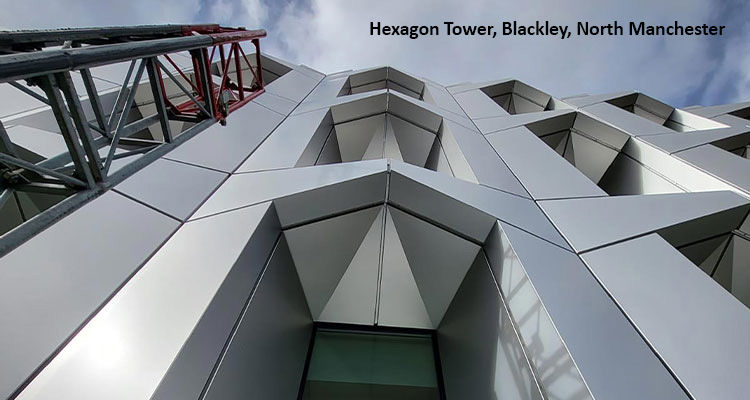
A prime example of this approach in action is the Hexagon Tower project in Manchester, which was a winner of the Facade Awards UK 2025 for best use of a rainscreen system using aluminium. This was a complex project to design and execute due to the building’s unique shape and lengthy reveals. The complexity of the project was naturally reflected in the pricing. For design build facades, price, compliance and longevity are linked and all depend on the quality of the design. The company must ensure that these structures are safe to build, and fortunately, the team on site devised a secure and effective construction method.
Building on this, Cliff Woodhouse, Business Development Director, adds: “Another key aspect is that we only engage in two-stage design and build. In the case of the Hexagon Tower, we began with a pre-construction services agreement. During this phase, we conducted all sorts of tests, mock-ups, and colour samples to refine the project. This process helped de-risk the project, so when it came time to establish a fixed price, we could do so with confidence, knowing what we were set to deliver.”
With decades of experience, a steadfast commitment to fire safety, and a design-build approach that ensures complete accountability from concept to completion, design build facades has established itself as a trusted partner for some of the UK’s most complex overcladding projects. As the industry continues to evolve in the wake of landmark legislation such as the Building Safety Act 2022, the company remains well-positioned to lead the way in delivering external refurbishment solutions that are safe, compliant, and built to last.