Despite being owned by Cornwall Council, Cormac is establishing itself as one of the UK’s largest highway maintenance organisations
Celebrating its 35th anniversary as a brand next year, Cormac was formed during the era of compulsory competitive tendering in the 1990s, originally established as a direct labour organisation of Cornwall Council with a highways remit. Over time, that role developed to the point where the organisation became an arm’s length company wholly owned by Cornwall Council in 2012. Thus, this year, marks 14 years since that transition. Across more than three decades, the business has diversified from a highway maintenance direct labour organisation into a multidisciplinary services provider delivering services across the built and natural environment. Still 100 per cent owned by Cornwall Council, Cormac focuses both on delivering against Cornwall’s priorities while also growing as a commercial entity through the non-council side of the business.
“We split our business into services and contracting services,” begins Dominic Bostock, Managing Director. “On the services side, we operate a fully integrated highway management service covering asset management, network management, customer and public interface, as well as the delivery of maintenance and improvement works. Environment is our second service area, where we manage and maintain a large proportion of Cornwall’s natural environment assets, collaborating closely with communities and local stakeholders to drive maximum community value from those assets. We also run a property maintenance, and facilities management business, and act as landlord to 120 houses used for temporary emergency accommodation. This creates real value against homelessness and supports Cornwall Council’s housing emergency, declared last year.”
Turnkey solutions
Cormac’s consultancy service covers technical design and engineering, spanning everything from structural work through to geotechnical expertise, which is particularly valuable in Cornwall given its extensive mining legacy and complex ground geology. Its support services include internal fleet operations, where the organisation owns and manages around 10,000 pieces of plant and equipment, as well as its own internal training service. This in-house training organisation ensures Cormac has the skills it requires today all while developing the workforce of tomorrow. On top of that, the company offers all the support functions expected within an organisation of its size.
“On the contracting services side, our focus is on infrastructure and civil engineering solutions delivered through a contracting organisation. Construction is a newer part of that offer, one that has grown over the last couple of years and that we hope to grow further. Rather than focusing on large buildings, we specialise in smaller construction, refurbishment and supporting clients in repurposing and improving existing assets. We also operate a recycling and aggregates business, including a quarry and an asphalt plant, which serves both our internal supply chain needs and external customers. Finally, our regional civil engineering business is the vehicle we are using to grow our services beyond Cornwall into Devon and the greater South West. Being able to bring all of these services together to offer a genuine turnkey solution is a key part of what sets us apart and delivering projects in each of these areas is very much what we do day to day,” Dominic notes.
Adaptable operating model
Cormac has become one of the leading advocates of the Teckal model, an approach that is growing increasingly attractive to local authorities. Teckal is a piece of case law, codified into previous procurement regulations, that gives contracting authorities the ability to create a limited company through which they can deliver services without going through a full procurement process. “That status depends on two things,” Dominic explains. “First, the company needs to be controlled in a way similar to how a council controls its own departments and directorates; our governance still links directly into council governance to satisfy that. Second, you need to carry out the majority of your work for your owner. We operate one company under that Teckal exemption, while a separate part of our business operates as a standard contracting organisation without that same requirement. Having both structures side by side gives us flexibility, and crucially ensures that our growth is never constrained by that majority-of-work test, because the second company can grow independently of it.
“The reason Teckal companies are becoming attractive is because authorities in the highways industry are recognising that they offer benefits beyond what a traditional outsourced arrangement would allow. With government funding and local priorities both shifting, the ability to vary and adapt specifications, scope and arrangements with a contractor you own is fundamentally different to trying to renegotiate a contract that might be five years into an eight-year term, with all the commercial barriers and risk that comes with it. That would make it difficult for an outsourced organisation to be as responsive. Traditionally outsourcing does not always give you that natural alignment with public service that comes from an organisation owned by the council itself,” he elaborates.
Economic development opportunity
Developing a reliable local supply chain has long been a priority for Cormac, and its collaboration with Courtney Plant Hire is a strong example of that commitment in practice. Long before social value became an industry buzzword, Cormac was already working to maximise its spend within Cornwall, particularly with SMEs, recognising early on that as the business grew, its supply chain would need to grow at the same time. Equally, Cormac has always recognised that certain niche and specialist requirements call for a national supply chain and larger organisations. “Our groundwork supply chain in particular has seen strong development over the last few years, with a number of organisations doubling or even tripling their revenue as a result of that growth journey, Courtney Plant Hire being a great example of that,” Dominic affirms.
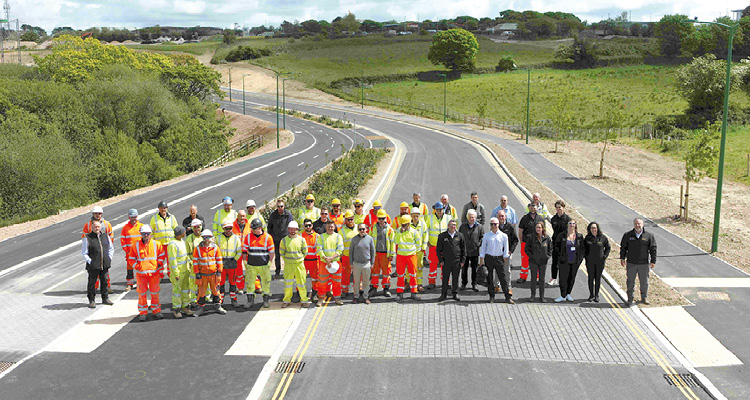
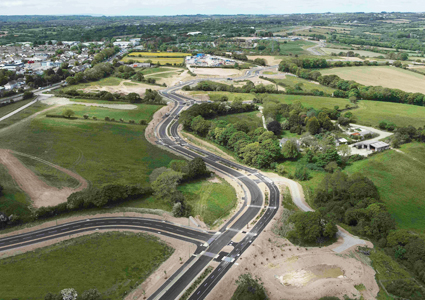
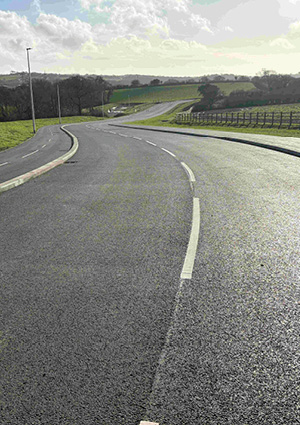
Among Cormac’s current projects is the Freeport Langage Access Road, a £4 million, 360-metre single carriageway spine road that will unlock almost eight hectares of employment land at the Plymouth and South Devon Freeport’s Langage site. “We have also recently completed the Northern Access Road, the spine road running from Royal Cornwall Hospital (Treliske) to Chiverton Cross roundabout in Truro,” says Tiffany Large, Commercial Director. “It was one of the largest projects we have undertaken, and it has been delivered successfully, opening up the next stage of development in Truro, Cornwall’s only city, through the Langarth Garden Village.”
On the topic, Dominic adds: “Langarth Garden Village is a housing development of 3500 homes and a great example of delivering infrastructure that supports economic, social and environmental growth. Together, these projects have unlocked significant residential development, and the Langage Freeport Access Road is a strong example of creating economic development opportunity by giving the Freeport the infrastructure it needs to build its units and attract further investment from companies into Plymouth.”
Championing collaboration
Beyond its work in Cornwall and the South West, Cormac has also built collaborative relationships with other highways arm’s-length companies across the country. This includes North Yorkshire Highways, a similar Teckal company owned by North Yorkshire Council; Via East Midlands, a joint venture Cormac established over a decade ago with Nottinghamshire County Council to deliver highway services in the county, now solely owned by Nottinghamshire County Council; and Norse in Norfolk. All four organisations collaborate in a similar environment, providing the wider industry with a reference point to help them understand how an arm’s-length company can operate and the value it can create for its owning authority, while also exploring procurement opportunities, economies of scale and the sharing of best practice and operational solutions.
“When you aggregate those four companies together, we are certainly among the top three highway maintenance organisations in the UK. Although we are not a single legal entity, are not part of the same group and are not owned by the same shareholders, we share similar objectives and operating environments. The collaboration and the value we can bring to one another, as well as the reference point we provide to highway authorities and wider stakeholders on how this model works and how it could work for them, is something we consider very important,” Dominic concludes.
Thirty-five years on from its origins in compulsory competitive tendering, Cormac has grown into something perhaps difficult to categorise, as it is part council asset, part commercial operator, part industry reference point for how the Teckal model can actually work in practice. Nonetheless, the Langage Freeport Access Road and Langarth Garden Village projects show what that structure can deliver on the ground. Additionally, Cormac’s collaboration with other arm’s-length companies shows what its structure and model can achieve at an industry level. For a company still wholly owned by one council, Cormac’s reach now extends far beyond Cornwall, both geographically and in terms of its influence across the sector.