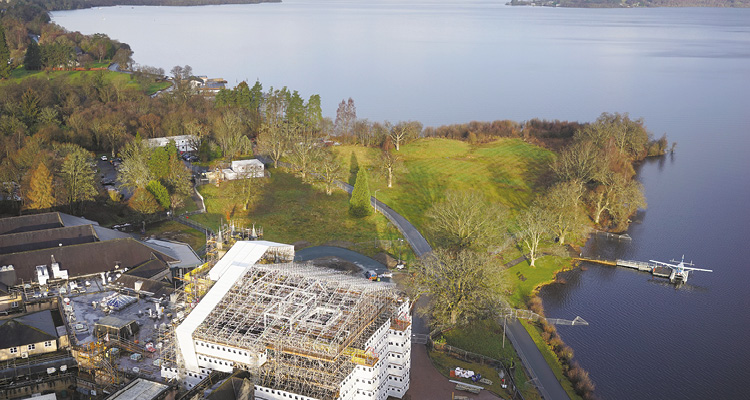
Discover what went into developing Enigma Industrial Services’ own training school
Enigma Industrial Services (Enigma) launched in 2018 following the acquisition of Interserve Industrial Services by a private company, but its roots run deeper. Tracing the company’s lineage back through its various iterations, the earliest predecessor organisation is Tilbury Douglas, established in 1935. However, the more significant starting point for the business as it exists today is the formation of Mills Scaffolding Company in 1949. Through a series of sales, the business changed names several times, including GKN Mills and GKN Kwikform. The engineering influence of GKN turned the company into a large manufacturer of scaffolding equipment, responsible for creating various innovative products. That manufacturing capability supported the development of a nationwide branch network offering scaffolding services across construction, infrastructure, housing and industrial installations, making Enigma one of the largest scaffolding businesses in the country through the latter decades of the 20th century.
Experienced teams
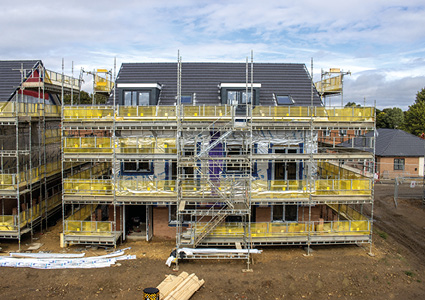
Today, Enigma operates across three distinct divisions. Paul Smith, Director of Operations, explains what each one focuses on and the markets it serves. “Our first division, Access North, provides a contract scaffolding service alongside the hire and sale of equipment in Scotland and the North East, operating from branches in Newcastle, Edinburgh, Glasgow, Dundee and Aberdeen. The division works across major new-build construction, housing, infrastructure and refurbishment projects, utilising both modular systems and traditional tube and fitting scaffolding. Serving most of the major contractors in those sectors, Access North has a well-established core of managers, supervisors and scaffolders capable of catering to all requirements.
“On the other hand, Access South covers the North West, Midlands and Yorkshire, the latter two being a result of both our desire to rebuild a branch network closer to the scale of the GKN Mills era, and of requests from customers wanting to work in those regions. The expansion into new locations is overseen by an experienced regional team that ensures standards, processes and procedures are consistently maintained. Access South operates across the same sectors as Access North and is supported by a team of eight temporary works engineers based in Glasgow, who provide engineering solutions for the most complex projects, including shoring, temporary roofs, gantries and more.
“Our third division is Industrial Services, which delivers industrial scaffolding solutions, specialist painting and coatings, insulation and industrial cleaning to the petrochemical, agrochemical, pharmaceutical, power and nuclear energy sectors. Having worked for many years on the nuclear decommissioning, waste management, and material storage site at Sellafield, and more recently on the new nuclear facility at Hinkley Point, we are used to managing the significant swings in manpower that come with large new projects and planned shutdowns,” Paul explains.
Focus on training
As he looks back on Enigma’s journey since its formation, Paul reflects on the values that have carried it through from the very beginning. “I like to think that the founders of this business would recognise that Enigma still operates by the same principles it was founded on. We understand that our people are our greatest asset, and that investing in their training and development benefits them as well as the company. In fact, we have maintained a steady stream of apprentices for many years, conscious of the industry-wide skills shortage and the need to attract new people into the trade. Over recent years, it has been more challenging to bring through apprentices due to the shortage of training places and the inconsistency in training quality available, which is why we have invested over £250,000 to establish our own training school for scaffolding apprentices. We currently have around 100 apprentices in the programme, with approximately 50 newly qualified Enigma scaffolders entering the industry each year through that route. Beyond apprenticeships, we are proud of the training that runs through every level of the business, with staff currently working towards NVQs at various levels and a number enrolled in degree courses covering project management and quantity surveying.
“I also think our founders would appreciate that while we are open to new systems and materials, we do not embrace change just for the sake of it. Many of the systems that worked decades ago still work today, and some have only needed modest modification to meet changing legislation. We have an in-house IT team that regularly reviews and improves our internal systems while monitoring the ever-growing threat of cyber-attacks, upgrading our protection as needed. Additionally, we have a team of experienced health and safety professionals who keep us ahead of legislative changes and work closely with our training team to ensure mandatory training requirements are always met or anticipated,” he adds.
Challenges and opportunities
To complement its investments in workforce and apprenticeships, Enigma’s main annual investment is generally allocated to new stock, with the bulk of recent spending directed towards HAKI system scaffolding. This measure helps address the skills shortage by enabling faster installation in certain scenarios and reducing the man hours required on site. Several million pounds have been committed to this system over the past few years. The company is also developing an in-house training course for estimators, which includes a degree of commercial awareness, after having identified a gap in officially recognised training for that role. There is more than enough knowledge within Enigma to create a comprehensive training course that can be delivered effectively to trainees, something the industry has lacked for too long.
Looking to the second half of 2026, Paul is conscious of both the challenges and the opportunities ahead. “Our priorities for the rest of the year are to work to the five-year business plan we have set out. Given the current socioeconomic climate, hitting our 2026 financial targets will be more of a challenge than we anticipated, but they remain attainable. Nonetheless, we will not compromise our principles on investment and training in order to reach them,” he concludes.