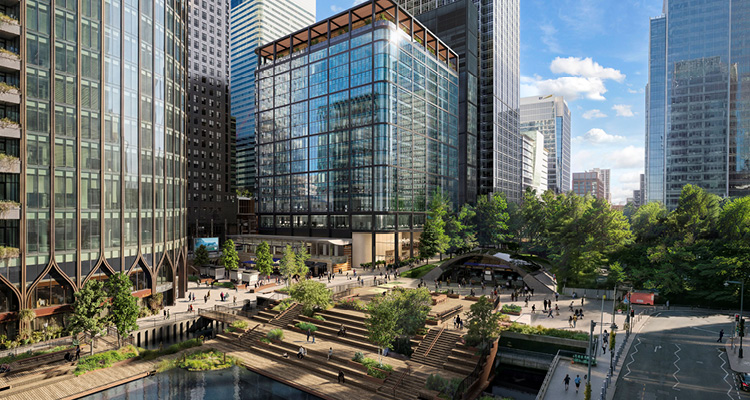
From circular concrete to swimming in historic docks, Canary Wharf Group is reinventing the district it originally built
“Quite a few of the core team here, including me, built these buildings first time round; Canary Wharf is where I started my career 33 years ago,” opens Alec Vallintine, Managing Director, Construction at Canary Wharf Group (CWG). “I handed over 8 Canada Square, colloquially known as the HSBC building, myself 25 years ago, and now we’re going back in, revisiting, refitting, and reworking the building for today’s needs. We’ve evolved from large commercial builders into residential, as we’re coming to the end of a scheme to deliver over 4600 apartments across the district. Now, we’re moving into heavy refurb work, which requires a whole new mindset.”
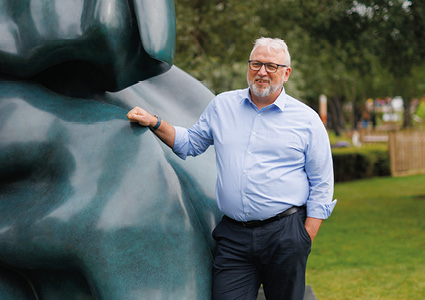
A quarter of a century after the first buildings were constructed, the group that built Canary Wharf out of the London Docklands is turning its attention inwards. With some of the original Canary Wharf buildings, CWG is taking on the challenging yet exciting opportunity to reconsider how those buildings serve the millions of people visiting the district in 2026 and beyond.
One Eden, otherwise known as 33 Canada Square, is CWG’s current retrofit focus. Originally occupied by Citigroup from the late 1990s, it was one of the first buildings the company completed after coming out of the administration of Olympia and York, which makes reworking it even more monumental. “It’s one of our babies, so it feels strange to be returning and repurposing it,” Alec says. “It’s interesting to see how much has changed over the last 25 years, particularly in terms of technology and environmental regulations. We’ve already seen interest, with PwC signing heads of terms for 350,000 square feet of the space.”
This project is the first of many buildings, as 8 Canada Square, colloquially known as HSBC tower, is back in planning. As one of the district’s most closely watched buildings, its owner, the Qatar Investment Authority, is working with the group on a plan to add hotel space, workspace, and leisure amenities. 10 Cabot Square, another one of the original phase-one buildings, is also being refurbished and will look completely different, with its design proposal having already drawn favourable feedback.
Improving performance
Alongside its retrofit projects, CWG is also constructing One North Quay, a new purpose-built, 823,000-square-foot vertical science and innovation campus in partnership with Kadans Science Partner. “One North Quay sits in a prominent spot as visitors drive into London or arrive by train, and it is designed for occupiers of every size, from ambitious startups to established global companies,” Alec expands. “The campus will be ready in autumn 2027, and we’re excited to get the infrastructure in place and bring people onto the site.”
While One North Quay is a new project, the engineering logic behind the repurposing of the district is that a well-built tower does not need completely replacing but rather modernising for today’s use. “We built these buildings extremely well, and the bones are still absolutely fine,” Alec elaborates. “The challenge is removing systems and services that have been running for 25 years and replacing them with new, energy-efficient plant, as well as improved cladding and roofing. One Eden won’t look much different on the surface, for instance, but it will perform significantly better. In fact, One Eden will retain 97 per cent of the existing sub- and superstructure, and the other three per cent is where the design has changed. In the new design, we’re amending the current atria, for instance, as customers now want access to outside air.”
As CWG is working on its own buildings, a clear advantage is the historic knowledge and expertise held by the company. “We’ve got so much data about this area, the piles, and the foundation performance, so we’re very comfortable with what we can add or remove,” Alec says. “A lot of the designs created 25 years ago were hand-drawn, but we’re now using survey technology like point-scanning and drones to create 3D models. On some of our new-build plots, like One North Quay, for example, we’re installing sensors in the piles to measure how they perform, which will provide data to help with future refurbishments.”
However, not every foundation is as easy to reach, as parts of Canary Wharf sit on marine decks over the dock. “People walk around and often don’t realise they’re walking over water,” Alec says. “Those piles go through the water and into the ground at the bottom of the dock. For buildings like 10 Cabot Square, we send divers down to inspect the piles and monitor degradation. Fortunately for One Eden and 8 Canada Square, these were built in a coffer dam, which makes this process a bit easier for us.”
While working on One Eden, CWG has been drawn into broader work around the sustainability of buildings and materials. “We’re using technology to challenge British Standards,” Alec states. “The work we’ve done with concrete, for instance, has evolved some of these standards, as we’ve added sensors and load cells into pours to reduce the amount of cement that goes into concrete. Collaboration is important to us; we want to create better standards across the industry, so we share any information and progress with others.”
Sustainable construction
Circular thinking also plays a key role in how the company considers repurposing not only buildings, but also the material itself. When North Quay’s century-old false quay was removed in early 2023 to clear the way for a science and innovation campus, the group worked with London Concrete to crush around 2500 tonnes of concrete into recycled aggregate, which was then used at Wood Wharf. More recently, the structures team turned used coffee grounds into biochar for a low-carbon concrete developed in collaboration with Holcim. The ‘bio-espresso’ mix was tested under a new piece of public art, and it cut the embodied carbon of that pour by a further 68 per cent.
At One Eden, CWG is also working with Saint-Gobain’s Glass Forever initiative, which returns demolished glass to the float-glass manufacturing process rather than downcycling it as aggregate. “The whole environmental push for sustainable construction is new territory,” Alec says. “Updated standards are set with little explanation or guide as to how construction companies can get there. We’re finding our own place and becoming a leader in the process that dictates change rather than being dragged by others.”
CWG’s retrofitting activities are also helping to challenge the misconception of Canary Wharf as a financial business hub. When we last spoke with Alec in 2023, he was keen to highlight what the area offers as a place to live, work, and play. Since then, footfall reached a record 76 million in 2025, up 5.4 per cent on the previous year, and Alec expects that figure to increase by the end of the year.
“People still think of the area as a collection of financial institutions with people in sharp suits, but it is so much more than that,” he says. “I’d challenge anyone with a preconception to visit and experience it for themselves. Our district now has more than 320 shops, bars, and restaurants, as well as padel courts, green spaces, a GP surgery, nursery, and primary school, with more than 5000 residents.
“I remember when the weekends here used to be really quiet, but now it’s absolutely buzzing; last Christmas, I popped out for a sandwich and could hardly move!” Alec laughs. “As footfall has increased, our tenant base has also shifted, and fewer than half of our key tenants are financial companies. We now have a vibrant mix of businesses including fintech and life sciences. Alongside footfall, 2025 also brought our highest level of office leasing in over a decade, with more than 780,000 square feet let to customers.”
Pioneering partnership
While revisiting the district, CWG is creating public thoroughfares and amenities at the base of each building, and many of them will also feature rooftop restaurants. “For example, alongside a rooftop terrace, retail space, winter gardens, and flexible workspaces overlooking the Eden Dock waterfront, One Eden will also have new direct access to the Jubilee line plaza, making it more accessible for visitors,” Alec shares.
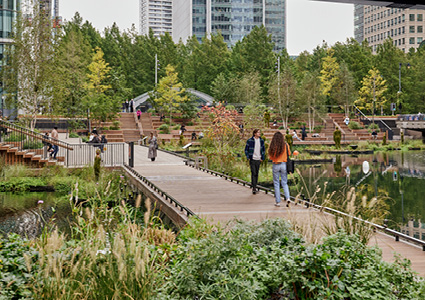
The group has also added a range of lifestyle-focused activities. In 2025, as part of a pioneering partnership with the Eden Project, the group transformed the historic Middle Dock into Eden Dock, a waterfront oasis of interconnected pontoons and aquatic islands. Expanding on some of the other initiatives, Alec continues: “This summer, we opened Sea Lanes, a floating lido that drew around 13,000 people in its first month! We’ve also trialled a new concept over the summer where we transformed a four-lane road into parkland with seating and green spaces, which has been a huge success.”
Together, CWG’s approach to reshaping public spaces focuses on ensuring Canary Wharf remains relevant to the people who live, work, and visit. With One North Quay due in 2028 and more of the original buildings still to be reworked, Alec sees the years ahead as a continuous process rather than a fixed project. “We’re always reassessing and realigning the district with today’s demands; ultimately, we want Canary Wharf to be an accessible and enjoyable space for everyone, for the next 25 years and beyond,” Alec concludes.