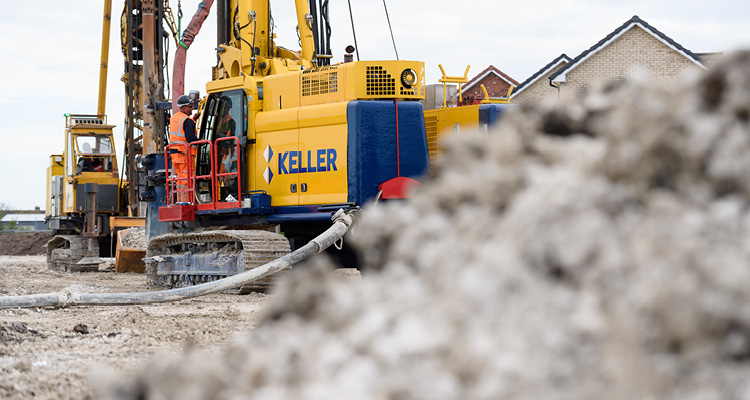
From HS2 to offshore wind, Keller UK is delivering geotechnical solutions that underpin the UK’s biggest construction projects
Every day, people across the UK live, work, and play on ground prepared by Keller. As the UK business unit of the Keller Group, Keller Limited (Keller) has been representing the group across the country since 1950. The business operates on a model of global strength combined with a strong local focus, allowing it to draw on worldwide expertise while remaining closely aligned to local market needs.
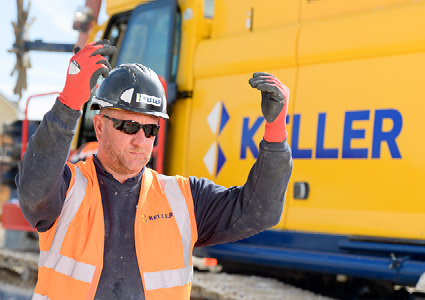
Not only is Keller the world’s largest geotechnical company, it is also a fully independent specialist contractor with a wide product portfolio. This means it can provide impartial advice to each client and design the best and most efficient geotechnical solution. Over the years, the group has pioneered many industry leading techniques, such as vibro piling and jet grouting, and continues to innovate through the development of specialist plant and new technologies. Keller offers the widest range of specialist geotechnical solutions available under a single brand in the UK market.
To learn more about UK operations, we speak with David De Sousa Neto, Managing Director, who begins by introducing himself. “I’ve been passionate about geotechnical engineering since my university days, and I have more than 30 years of experience in the industry, 26 of which have been with Keller,” he begins. “After working across Sub-Saharan Africa and Brazil, I joined Keller UK as HS2 C1 Project Director before stepping into my current role in 2023.
“In the UK, our work covers ground improvement, piling, diaphragm and slurry wall construction, specialist grouting, instrumentation and monitoring, retaining wall systems, embankment and slope stabilisation, soil mixing, and more. This breadth of capabilities means we can combine methods to suit the ground conditions, construction constraints, and performance requirements of each site, always delivering on time, within budget, and to the required performance standards.”
Having both retaining solutions and monitoring and instrumentation capabilities within Keller UK brings practical benefits to its clients, allowing project teams to look at problems more holistically. “Many projects today require more than one geotechnical solution, and clients increasingly recognise that there is better value in working with a contractor who can deliver these services together,” David confirms. “Our approach gives clients a single point of contact across a wider part of the project, which improves accountability and simplifies communication. We are directly involved in both the construction and the monitoring, meaning we can respond quickly as data becomes available and adapt our designs or construction methods in real time if ground behaviour changes.”
Despite current challenging conditions in the UK’s construction industry, Keller UK has a strong order book and is playing a key role in the country’s critical infrastructure projects such as HS2 and Tata Steel’s new electric arc furnace facility at Port Talbot. “We have a long history of delivering major infrastructure projects with complex geotechnical requirements, including the 2012 Olympic Stadium in Stratford, Crossrail, the Victoria Station upgrade, and more recently the Teesside wind turbine monopile factory,” David reflects. “Each of these projects required tailored solutions, careful coordination, and a deep understanding of ground behaviour.”
Impressive project portfolio
Turning to HS2, David continues: “Projects on the scale and complexity of HS2 are exactly the type of work where Keller excels. We’ve been involved across most sections of the HS2 project; in the southern sections, S1 and S2, we delivered complex anchoring and jet grouting works in challenging ground conditions; and across the central sections, including C1 and C2/C3, we were responsible for delivering everything from highly controlled, precise grouting works through to major foundation construction for the iconic Colne Valley Viaduct, where we installed piles up to two metres in diameter and down to depths of around 55 metres. Our involvement on the northern sections, N1 and N2, is also progressing well, particularly on highly specialist and technically demanding grouting works.”
On Port Talbot, David is equally enthusiastic: “Being involved in a project of this scale, particularly one focused on sustainability, is something of which we are extremely proud. The move to electric arc furnace technology represents a major step in reducing the carbon footprint of UK steel production, and we believe the project will deliver lasting benefits for the local community, the environment, and the wider UK economy.”
On the topic of sustainability, Keller UK also delivered the foundations for the world’s largest offshore wind monopile factory. “This was a great project and one that was genuinely meaningful, both for the UK and for the environment,” David comments. “At peak delivery, we had up to 24 of the largest piling rigs operating on site, installing more than 8000 piles, typically to depths of around 25 metres in extremely stiff ground conditions.
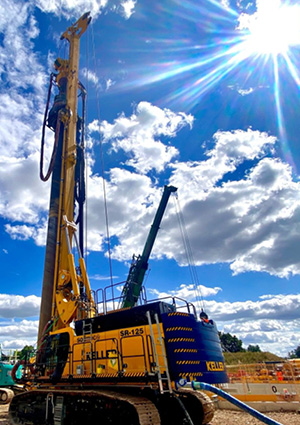
“Another area we’re particularly proud of is the work we have done in the UK to design and build our own electric piling rigs. Most recently, we designed and built a fully electric vibro rig for stone column installation. After successful testing at our main yard in Coventry, where it proved to be both efficient and dependable, we are now planning to build additional units. Alongside this, all the rigs in our wider fleet that are not electric are powered by Tier 5 engines and can operate on HVO and other biofuels, which significantly reduces emissions compared to older equipment.”
Sustainable growth
While projects are crucial for the company’s growth, David is keen to highlight that Keller’s people are at the core of its success. “Our people are the foundation of our business, and nothing is possible without the contribution of every member of our team,” he states. “We are fortunate to have many colleagues with long service, but it is becoming increasingly difficult to attract new talent. To address this, our STEM ambassadors regularly visit schools, colleges, and universities, and the group offers great career opportunities, including working overseas and the KWIC (Keller Women in Construction) network.”
With a healthy order book in place, critical projects underway, and an ongoing commitment to continued growth, 2026 looks to be another successful year for Keller UK. “Our focus is on delivering current projects to the highest possible standards,” David concludes. “A major part of our workload will be the Port Talbot electric furnace project, which we believe will be a true milestone for the Keller Group, alongside infrastructure works at Sizewell, major data centre projects, and several dam and water management schemes. Long-term relationships with all stakeholders remain fundamental, and sustainable growth is also a priority. Our core values of collaboration, integrity, excellence, and sustainability will continue to guide how we work, and by staying true to those values, while continuing to adapt and improve, we are confident in our ability to succeed.”