FT Pipeline Systems invests in people, technology, and infrastructure to prepare for the UK water sector’s next chapter
From corrosion protection and specialist coatings to fittings, logistics, and installation support, FT Pipeline Systems (FTPS) champions a complete, project-led approach to drive long-term pipeline performance. With its legacy spanning back to 1982 when Robert Frazer and Horace Tabberer founded Frazer & Tabberer, the company has provided end-to-end pipeline supply and project management to the UK water industry with an estimated 400km supplied over the last 15 years.
Today, quality and whole-life cost are at the heart of FTPS’ approach. Backed by strong supply-chain relationships, technical expertise, and extensive experience managing complex projects, the business proudly delivers a complete service that gives clients confidence from specification through to installation. The company is now applying this expertise across a broader range of infrastructure projects while maintaining the high standards of service on which its reputation has been built.
FTPS’ Managing Director, Ian Harding, has been with the company since 1997. Throughout his tenure, he’s supported its evolution through thick and thin, celebrating its many wins and tackling various macroeconomic challenges, including the banking crisis of 2009, Brexit and Covid-19. When he last sat down with Construction & Civil Engineering, we took a deep dive into FTPS’ investment programme, focusing on its strategic investments in its team, technology, and carbon neutrality initiatives. Since then, the business has continued to invest, uniting with its partner businesses under Frazer & Tabberer Group Ltd. However, navigating new major projects amid the turmoil of the current economic climate, is not without challenges. We reunite with Ian to find out how the company is preparing.
“The projects are coming, but we need to be positioned to help deliver them,” he says. “We are facing challenges in terms of carbon and rising costs because we supply steel, as well as being affected by the situation in oil and energy. There’s further uncertainty with Ofwat being abolished, and a new regulator to be put in place to cover Ofwat’s previous workload along with the Environment Agency, Natural England and the Drinking Water Inspectorate, however, there is a programme of spending that needs to happen. We are therefore still sitting tight and waiting for that spending to come through.
“The positive side of this is that we are continuing to invest and prepare for what is coming,” Ian continues. “We are a small organisation, so we must remain lean. Because of that, we’re continuing to invest in our people. Our QA control app, too, is now operational, and has been used as part of our delivery programme for Anglian Water’s Interconnector Phase Two (IC2) project. It’s proving to be a useful tool, allowing us to record each asset and give the client greater visibility.
“We are also investing in technology and making greater use of AI. For example, when we are creating documentation, policies, and other materials, AI can assist us with the work we need to do. We have our ISO recertification coming up in two weeks [at time of writing], so having that support helps us make sure we remain compliant, accredited, and in a position where water authorities and their contractors can continue to use us. We’ve also acquired a new warehouse storage facility.
“We have put stock on the ground and committed capital so that we are ready to go when the market picks up. Ultimately, it’s all about ensuring that we remain relevant and visible to our client base.”
Project pipeline
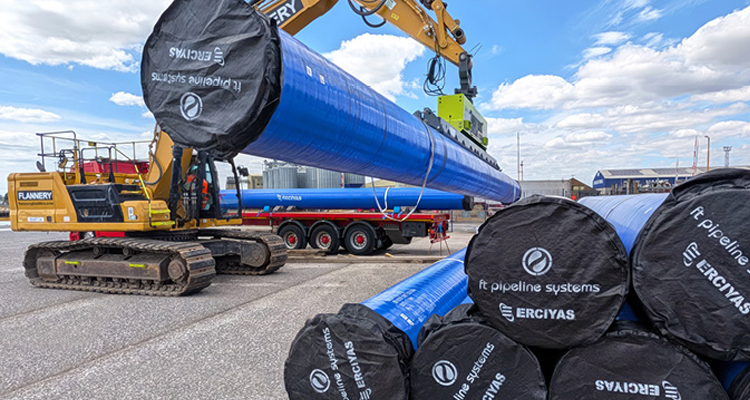
Despite the current difficulties, FTPS is continuing to invest in its people, technology, stock, and facilities, effectively positioning itself to respond accordingly when planned investment in the water sector gathers pace. One such opportunity, as Ian details, is Anglian Water’s IC2 project, where FTPS is already supporting the delivery of critical pipeline infrastructure. Stretching 260 kilometres, the new pipeline will enable water to be moved from North Lincolnshire to areas across the East of England where demand is higher, including Cambridgeshire, Suffolk, Norfolk and Essex. The scheme represents a major investment in the region’s water network and will play an important role in strengthening long-term supply resilience to the “Nation’s Breadbasket”
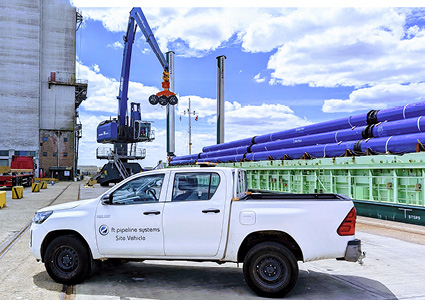
“We are in the process of supplying 34 kilometres of large diameter, coated, and lined steel water pipe. The pipework is generally supplied in 14-metre lengths, with each pipe weighing approximately 2.5 tonnes,” Ian elaborates. “The vessels are arriving through King’s Lynn, with a total of five vessels planned, each carrying around 500 pieces of pipe. King’s Lynn is a relatively small port, so we must be very specific about the size of the vessels we use to ensure they can access the port. We have a team on site working with the Port Authority and Associated British Ports to discharge the vessels and stack the pipe safely and neatly. This is done using vacuum lifting equipment at the port, together with our own team. The vessels are arriving approximately a month apart. We have had three deliveries so far, with a slight break planned in October, before the final two vessels arrive around November. From there, we’ll facilitate the onward delivery of the pipe to the customer’s site.”
People-centric approach
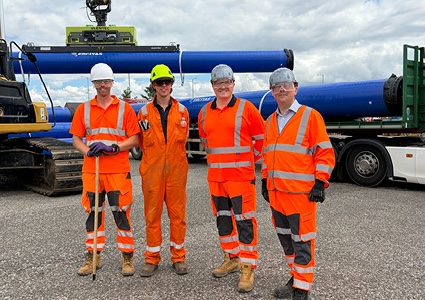
The scale and complexity of the IC2 deliveries also highlight the importance of having the right people on the ground. This is symbolic of FTPS’ most important asset of all: its dedicated and skilled team. For Ian, the company’s people-centric approach extends beyond any given project and runs deeply within its DNA, shaping how FTPS builds its team and engages with the wider community. This, he says, is an integral part of driving the business’ success.
“We’re pretty relaxed as an organisation; I don’t run a nine-to-five operation,” he affirms. “We’ve got a good team. At this time last year, I had three employees; I now have six. We’ve also taken on a young CAD Technician graduate who was struggling to find work despite having a first class honours degree. Most of these are people I’ve met through playing hockey for Sutton Hockey Club. It really underlines why sport and community engagement are important; it creates connections. People do their best, and if we can support those individuals to exceed expectations and excel in themselves, then that is what we should do. That includes personal development as well as the development of the company.
“In addition, we prefer face-to-face meetings. Business is about people buying from people. That’s how it used to work, and I think there is a danger that with AI, Teams, and other technologies, we’ll lose that personal connection.”
As FTPS looks to the future, its approach remains centred around investing, adapting, and staying close to its customers. From major infrastructure projects such as IC2 to continued investment in its people, technology, and capabilities, the business is building on its experience while preparing for what comes next. In an increasingly complex market, FTPS continues to prove that long-term success is built not only on technical expertise, but on the people and relationships behind it.