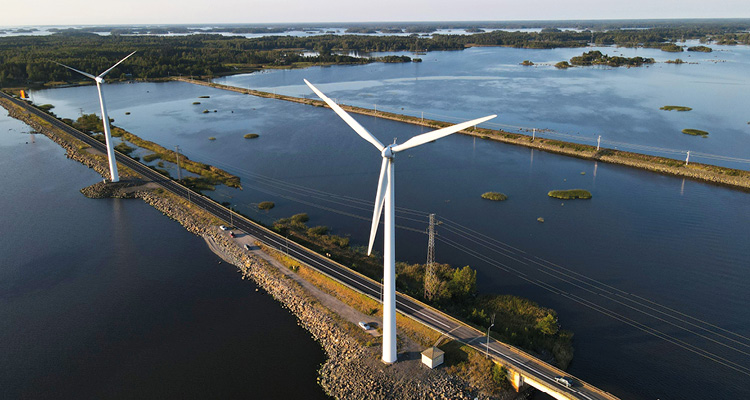
GRK is positioning itself at the forefront of sustainable infrastructure and clean energy network construction
With a proud history tracing back to 1983, today, Graniittirakennus Kallio Oy (GRK) has become one of Finland’s leading infrastructure companies. Founded by the Kallio family, the company initially focused its operations on property ownership and development, before expanding into infrastructure construction in 2007, which now constitutes its main line of business. The company designs, repairs, maintains and builds roads, highways, railways, tramways, metro lines and bridges to make everyday life run smoothly.
Although based in Finland, GRK also operates in Sweden and Estonia, with clients including government, municipalities and cities, as well as the private sector. CEO Mika Mäenpää reveals more about the company’s expansion and ongoing projects.
“GRK’s actual growth began in 2010, when 21 new shareholders joined the company,” he begins. “We have always been largely owned by employees who are actively involved in the company’s daily operations. Since then, we’ve grown rapidly and most of this growth has been organic. Last year our revenue was approximately €870 million, with over 1200 employees.”
Organic growth
With services covering road, bridge and railway construction, civil engineering, industrial construction and related design, GRK also has an environmental technology business which covers the reception, processing and utilization of various waste materials and by-products from industry and power plants. It also has GRK Power, which focuses primarily on the construction of electricity transmission networks (110/400 kV) and substations.
Operating through local companies in Finland, Sweden and Estonia, GRK ensures proximity to customers and market-specific expertise, applying common ways of working across the group with a focus on profitability and a strong entrepreneurial culture. “We combine organic expansion with targeted acquisitions, particularly in Sweden, where we see the strongest growth potential,” continues Mika. “Expansion in Sweden is one of our strategic goals – the infrastructure market continues to grow in all our operating countries, but the biggest growth can be seen in the Swedish market. The growth is supported by the national transport infrastructure programme for 2026-to-2037, as well as continued investments in electricity networks, water infrastructure and defence-related projects.”
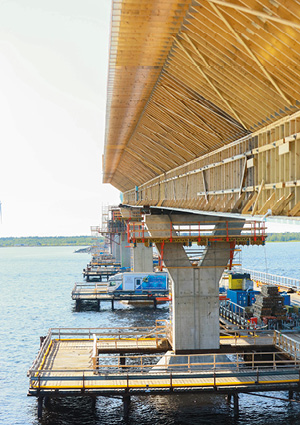
GRK’s 20 per cent revenue growth in 2025 was driven primarily by the progression of its largest projects, which Mika says advanced better than planned due to additional orders received, a moderate level of overhead and favourable weather conditions. This year sees the continued development of a third Norrbotniabanan project – a bridge infrastructure project the company was selected for in Sweden. “Being involved in the construction of the new coastal railway from its very early stages is significant for us,” notes Mika. “Our goal is to grow our business in Sweden and build a diversified order backlog, and this project supports that objective extremely well.”
Efficient execution
As sustainability is becoming increasingly central to infrastructure, GRK aims to strengthen its role in green transition projects. “The successful green transition in Finland requires significant investments in increasing the capacity and flexibility of electricity networks and substations,” highlights Mika. “As a result, additional construction of electricity transmission networks and substations are both timely and necessary. The growing need for electricity grid infrastructure further reinforces the overall demand for infrastructure construction.
“Many industrial sectors are currently investing in the green transition, and projects related to the sustainable transformation of industry, as well as the construction of energy infrastructure, are driving growth in infrastructure construction. Energy efficiency, circular economy, low emissions and avoiding biodiversity loss are at the core of sustainable infrastructure construction – we already have strong references from green transition projects, including clients such as Stegra and SSAB in Sweden.”
Recently recognised as Finland’s most reputable construction company, GRK has built trust over many years by delivering quality work. “We work closely with customers and partners to make projects run smoothly and reliably. Another core value is that we do not waste time, which shows in our fast response times and efficient execution,” explains Mika. Over 40 years, GRK has evolved from a primarily local contractor into a partner capable of delivering large, complex, and long-term infrastructure projects. “Today, we are actively involved in multiple alliance projects, including the Vantaa tramway, track maintenance in Uusimaa and Southwest Finland, and now also Turku Tramway project.”
Discipline and determination
Entrepreneurial culture and strong values remain key to GRK’s success. “One of our strategic approaches is fostering close collaboration across our operating countries and business areas. We want our experts to be able to move flexibly between countries and business lines,” adds Mika. “We also recognise that attracting skilled and motivated professionals is a challenge across the construction industry. Our goal is to attract and retain the best skilled experts. Moreover, we want to be a company that develops its own talent for current and future projects, which is why we employ more than one hundred trainees every year.”
For the second half of 2026, Mika says the construction season will be at its busiest over the coming months. “At GRK we have several new and ongoing projects currently under way. Our priority is to deliver these projects in our typical manner with high quality and a focus on safety while maintaining solid profitability.” He describes the outlook for the remainder of the year as positive. “We have a strong order backlog. There is significant work ahead, and we are well positioned to continue executing our strategy with discipline and determination.” Looking further ahead, the company’s strategy is set through to 2028 – with an ambition to continue growing profitably and be a forerunner in sustainable construction.
“The core principle of our strategy is to ensure healthy profitability in everything we do. Our objective is that within three years, we will have achieved the targets set out in our strategy. Regarding our financial targets, our aim is to increase revenue to more than €950 million by 2028 while maintaining an adjusted operating profit margin of over six per cent over time. We are committed to a healthy capital structure, with net debt to adjusted EBITDA remaining below 1.5 times. In addition, our target is to achieve a return on capital employed of more than 20 per cent. We also aim to distribute increasing dividend, amounting to at least 40 per cent of annual net profit over time.
“Likewise,” he concludes, “we want to reach our sustainability objectives. These include maintaining excellent employee and customer satisfaction levels and further improving safety. We also aim to have made clear progress towards our long-term target of achieving net-zero carbon emissions from our own operations by 2035.”