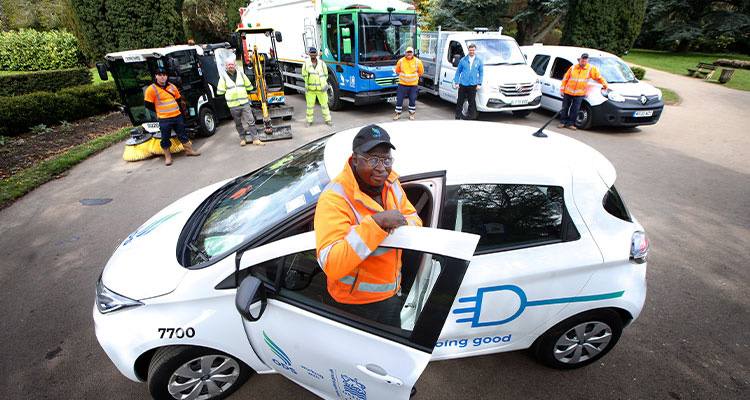
How ODS Group is building on its public sector roots to become an integrated, community-first business
On a mission to ensure Oxfordshire is a great place to live, work, and visit, ODS Group (ODS) provides cost-effective commercial and public sector facilities management. Since its inception in 2018, ODS has supported more than 2000 businesses and over 150,000 residents across Oxford, with specialist teams to deliver a range of services including maintaining fleet vehicles and highways, managing landscapes, and delivering total waste management solutions.
“ODS is a complex business, but our vision is to make your part of the world a great place to work, live, and visit,” opens Simon Howick, Managing Director. “Ten years ago, we were a department of Oxford City Council, with around 550 staff delivering a range of public services in Oxford. We also sold some of our services to other businesses, which enabled us to generate profit that could be reinvested back into public services at a time when government grants to local authorities were being reduced, making it an increasingly important income stream.
“There is, however, only so much commercial activity you can undertake within a council structure, so after a strategic review, we concluded that establishing an arms-length trading company would be the best way forward. Since then, we’ve trebled our commercial business while continuing to deliver high quality services in Oxford and the wider region. We’re committed to building a business that’s good for everyone; one that creates an inclusive and sustainable economy; balances purpose and profit; and considers the impact of decisions on employees, customers, suppliers, community, and the environment. This triple bottom line strategy is central to our ‘Doing Good’ purpose.”
Diverse capabilities
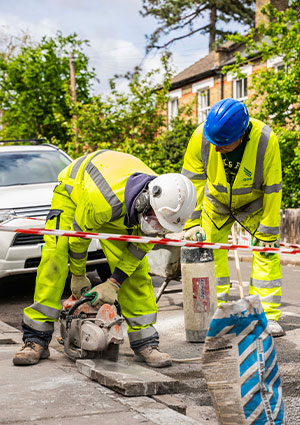
Today, ODS generates close to £100 million in annual turnover and operates an extensive fleet across Oxford and the Thames Valley. Elaborating on the company’s capabilities, Simon continues: “Our infrastructure services include construction projects from small refurbishments to large new build schemes, as well as highways and engineering works such as groundworks, drainage, minor works, carriageway surfacing, pothole repair, and flood defence. In Facilities Management (FM), we deliver property maintenance and planned works, retrofit and decarbonisation schemes, grounds maintenance, and pest control. We offer an integrated solution for managed services, taking care of everything both outside and inside the building. In addition, we run a significant commercial waste operation serving more than 1200 customers, and we manage and maintain commercial and light vehicles.
“We also have a construction division, operating as a main contractor for new build and refurbishment works ranging from £25,000 to £10 million. We focus on regeneration with an emphasis on sustainable construction and improving the performance of existing buildings. Operating across both traditional and design-build approaches, we offer a turn-key solution, and we recently showcased at the Listed Property Owners Show in London to highlight the expertise we bring to listed buildings and heritage sites.”
Trusted partner
ODS is constantly enhancing its capabilities, and the recent innovation of Gul-e, an innovative EV home charging system, has shifted the business from solely delivering services to actively creating innovative solutions. “I am particularly proud of Gul-e as I remember being in the initial meeting, watching what began as a simple sketch on a whiteboard gradually evolve into a fully tested, market-ready product,” says Jason Munro, Director of Infrastructure. “This journey taught us a great deal about product development, regulatory compliance, technical assurance, and customer engagement, and we now have a deeper understanding of these challenges.
“Gul-e has strengthened our range of low-carbon solutions, which also include EV infrastructure, solar PV, and heat pump technologies,” Jason explains. “We can now support clients from the pavement to the rooftop, delivering integrated whole systems rather than isolated solutions. Whether it’s civils and highways adaptations, EV charging access, renewable energy generation, or building-level heat decarbonisation, ODS provides a coordinated, end-to-end service through a single trusted partner.”
On the topic of enhanced capabilities, ODS has recently launched a new integrated facilities management initiative called oxfordworkplace in collaboration with partner Q3 Services Ltd (Q3). “This represents more than a new service line, but rather a deliberate move towards true service integration, bringing together construction, engineering, maintenance, and workplace services under one coordinated operating model,” Simon shares. “Traditionally, buildings are handed over to an FM provider once built, but this can create fragmentation, duplicate effort, and avoidable costs over the life of the asset.
“However, through oxfordworkplace we are creating a clear route to integration. Our in-house delivery teams work alongside FM specialists from the earliest stage of a project to ensure decisions made during the design stage directly support long-term operability, compliance, energy performance, and lifecycle planning. By combining our local delivery experience and public sector heritage with Q3’s national reach and compliance expertise, we can provide clients with fewer interfaces, better data, clearer reporting, and improved cost certainty. oxfordworkplace is therefore not simply an expansion of our commercial offer, but a strategic evolution towards becoming a fully integrated, outcome focused service partner, designing, maintaining and managing buildings with their entire lifecycle in mind.”
Oxford workplace is just one example of how ODS provides integrated value. Emma Hope, Social Value Lead, explains the company’s strategy for supporting the communities in which it works: “Our purpose is simple – we’re here to do good, and we run our business to create value for everyone. Every pound of profit is reinvested into the essential services our city depends on, and we work closely with our community, customers, and supply chain to identify the areas of greatest need. We’re committed to measuring our impact, understanding the change we create, and demonstrating our social return on investment; we want to prove that a business that creates value for everyone is a stronger business overall.”
Focusing on evolution
As our conversation draws to a close, Simon shares more details about what’s next for ODS. “2026 is about continued growth, as more profit means more funding reinvested into essential public services,” he says. “At the same time, we’re focused on evolving beyond single service lines to become fully integrated, managed services provider delivering a range of positive outcomes for businesses across the region. This would enable us to provide more value to our clients through streamlined, coordinated services while strengthening our operational capability and long-term sustainability.”
Growth plans aside, the UK’s wider political landscape presents some uncertainty for ODS. “Our shareholder, Oxford City Council, is part of the national Local Government Reorganisation, so the longer-term landscape is somewhat uncertain at the moment,” he concludes. “Assuming this policy continues, Oxford City Council will not exist in its current form, meaning our shareholding will be passed to a new entity. Regardless of these changes, we see significant and exciting opportunities for ODS to grow into a larger and more influential business in the years to come.”