Jarvie Plant blends family values and innovation to fuel growth across Scotland and Northwest England
Being a third-generation, family-owned and run business, Jarvie Plant prides itself on remaining true to the values it was built on, alongside continuous innovation and a highly progressive attitude. “Throughout four decades, we have never stood still,” declares David Jarvie, current Managing Director, and grandson of the company’s founder and son of Chairman John Jarvie. “We were one of the first companies to introduce telehandlers and standalone welfare units into the Scottish hire market in the 1970s and 1980s.”
The Grangemouth-based company was formed in 1960 and, spanning more than 65 years, Jarvie Plant has grown from a traditional plant hire company into a much broader hire and site solutions business. Although it may be a smaller independent business in comparison to many large corporations, Jarvie Plant certainly isn’t overshadowed by giants – instead, it combines family principles, accountability, and long-term visions with ambition, investment, and capability.
“The business and the industry have changed enormously, but the fundamentals have not: invest in good people and equipment, look after customers, and take a long-term view,” David emphasises, describing the firm as a ‘total site solutions’ business, rather than merely a plant hirer. “Our traditional plant fleet remains at the heart of the business, with excavators, dumpers, rollers, and compaction equipment.” The business also provides telehandlers and access equipment, generators and lighting, site accommodation, modular buildings and welfare, commercial vehicles, and a wide range of smaller plant and site equipment.
“A vital distinction is that we are not simply family-owned – the Jarvie family has actively built and run the business across three generations. My grandfather founded the business, my father, John, is Chairman and built the business through our hub depot in Grangemouth, and my uncle Gordon has played a pivotal role in our success too, particularly in building a reputable accommodation division across Scotland. I am the third generation to lead the business, and there is a huge sense of responsibility that comes with that.” The group now has multiple depots across Scotland and a further presence in Northwest England, just outside Manchester. “For us, it’s personal. Our name is above the door, and we’re close to our customers.”
David tells us another significant part of Jarvie Plant’s future growth comes from selling complete solutions. “We want to bring all of that together for the customer and support a project from site set-up through to completion, with the plant, welfare, accommodation, power, and vehicles it needs.” Until now, the company’s growth has been fuelled by “long-term thinking, continuous reinvestment, and a real drive to succeed above all,” he highlights.
Being independent allows Jarvie Plant to invest in fleet, people, depots, and technology, and consistent reinvestment has allowed the business to keep evolving – from first introducing telehandlers into the Scottish market to founding its vehicle rental business and developing a Customer Solutions operation. Perhaps most important are the business’ relationships. “We have customers, employees, and suppliers with whom we have worked for many years,” David relays. “That trust is incredibly valuable and something we work hard to protect.”
Fleet expansion
For a company that never stands still, innovation is at the heart of its operations. As part of its total site solutions strategy, Jarvie Plant recently launched a House Builder Package, aimed towards one of its most crucial markets. “We’ve been supplying home builders since the 1970s with accommodation, telehandlers, and plant. The lifecycle of a housing development begins with site establishment and groundworks, then continues through the build – from roof trusses to drainage, landscaping, and completion,” David explains. “The House Builder Package makes that easier for the customer by bringing those requirements together through one relationship with us, instead of sourcing everything separately.”
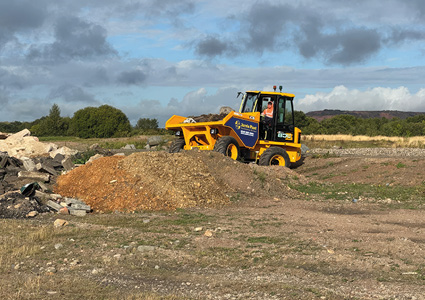
After adding over 200 vehicles in one transaction last year, Jarvie Plant is continuing to expand and modernise its fleet, giving it the platform for further growth across the whole of Scotland. One example is its investment with Scot JCB, which added 168 new machines during 2025, including tracked excavators, backhoe loaders, telehandlers, site dumpers, compaction rollers, a wheeled excavator, and 73 generators.
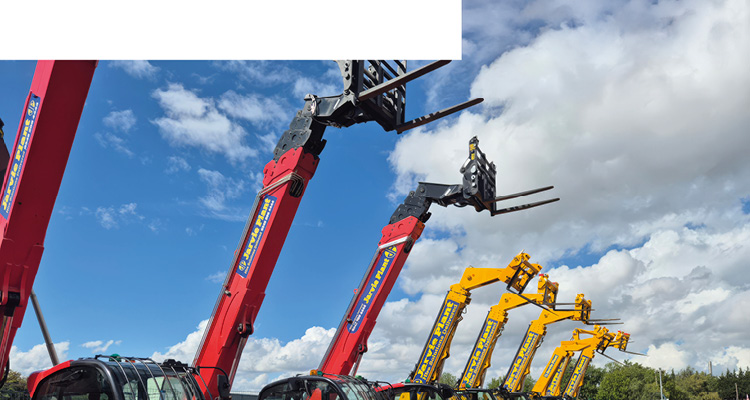
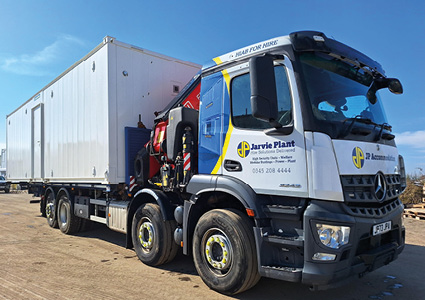
“More recently, we added our largest rotating telehandler to date – a Manitou MRT 3570,” reveals David. “We expect to increase this to two machines next month [at the time of writing]. On the civils side, we are broadening our range to meet demand for wheeled excavators, including 11T and 16T models from Develon and JCB, as well as 14T-25T tracked excavators from CAT, JCB, and Komatsu. We are expanding our specialist earthmoving fleet with Hydrema rear-tipping ADTs and Morooka tracked dumpers, including the latest MST80-C model, which are increasingly required for Highland projects involving steep climbs and low ground pressure. Our accommodation fleet is also growing, with further investment in solar welfare units, Eco settler units, and modular JPX buildings, including several large compounds due to be installed before the end of the year. Together, these investments support our wider theme of ‘Scaling Up for the Future.’
“We are also looking beyond the machine itself; Trimble Earthworks GPS-enabled machines help customers improve excavator accuracy by combining GPS positioning, 3D design files, and in-cab displays, reducing manual surveying and grade checking. Safety Shield AI human-form recognition has been introduced to parts of the fleet, while JCB LiveLink provides real-time data to support preventative maintenance and environmental reporting.”
Sustainability and efficiency
By buying in equipment, Jarvie Plant is not only increasing the size of its fleet but also making it younger, safer, more efficient, and better aligned with the sectors in which it sees plenty of future demand. Furthermore, the company’s investments align with its wider sustainability goals, which David notes must be practical. “We are committed to the transition towards lower-carbon construction, while recognising where the technology and supporting infrastructure are today. There has been significant progress with electric equipment, HVO, hydrogen, and other alternatives, but the industry still has a considerable way to go. We’re helping move that transition forward, by introducing a fully electric rotating telehandler, investing in solar and eco welfare, lighting products, and battery storage units which combine with our generators to reduce fuel costs and noise, and the continued replacement of older equipment with newer, more environmentally friendly machines.”
With systems such as LiveLink providing customers with emissions and efficiency information, technology is increasingly important too, as it helps the company identify potential faults before resulting in downtime. “Our sustainability strategy is about the complete fleet,” David continues, listing modern equipment, alternative technologies, better information, improved utilisation, and less unnecessary downtime as key elements of the initiative. “Ultimately, sustainability and efficiency increasingly go hand in hand.” Digitising the hire journey from end to end is also part of Jarvie Plant’s plan, combining mobile deliveries and job cards through Spartan’s Phalanx, a suite of mobile apps and tools.
“Our dynamic online hire catalogue is designed to transform how customers manage their account and hires, which is another exciting development, and we are incredibly pleased with this progression,” concludes David. “Overall, we are most proud of being a family business dating back over six decades. I am honoured to be the third-generation leading Jarvie Plant – we are not just family-owned, we are family-run, and that responsibility and drive to succeed are personal. I truly believe that gives us an edge; one that publicly run businesses cannot easily replicate.”