Kilmac enters its next chapter with employee ownership, technological investment, and ambitious plans for growth across Scotland
From its roots in Tayside, Kilmac has grown into a leading Scottish civil engineering and groundworks contractor, delivering complex infrastructure, commercial, education, and development projects across the country. The company’s core expertise lies in civil engineering and groundworks, particularly where projects present technical challenges and early contractor involvement can make a real difference. From earthworks, drainage, roads, and infrastructure to reinforced concrete, foundations, utilities, external works, and complex ground engineering solutions, Kilmac consistently brings the skills and experience needed to turn demanding plans into deliverable projects.
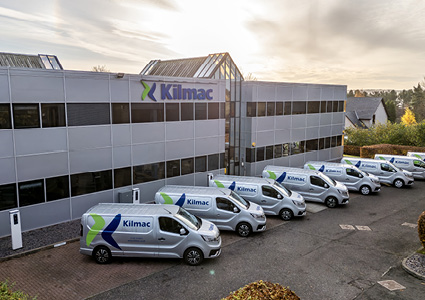
When Construction & Civil Engineering last sat down with Athole McDonald, Group Director of Kilmac, in 2024, we discussed the company’s continued turnover growth and developments in Dunfermline and Perth, which included the construction of the first Passivhaus primary school in Scotland. Additionally, Athole revealed that Kilmac had transitioned to employee ownership in 2022, which is already translating to positive impacts across the company. Now, we rejoin Athole to find out more.
“Operationally, many of the fundamentals of Kilmac remain the same. What has changed is the structure around the business and the sense of long-term ownership,” he explains. “Kilmac now operates with a Board of five Directors which is accountable to the Employee Ownership Trust Board. The Trust Board brings together representation from employees, directors and external advisers, providing an additional level of governance and ensuring the long-term interests of employees remain central to the business.
“Perhaps the biggest change has been cultural,” Athole says. “We’re seeing the next generation of management stepping forward and taking greater responsibility. That transition has not been without its challenges, but it has been extremely encouraging to see the appetite among our people to develop and take on senior roles. At the same time, experienced members of the business are increasingly focused on mentoring and transferring knowledge to that next generation. For us, that is one of the most important measures of whether employee ownership is succeeding.”
Since our last conversation, Kilmac has continued to expand further across the Central Belt and towards the west of Scotland. Green building has become a central tenet of its offering.
“Sustainability has become a fundamental part of Kilmac’s strategy rather than simply a requirement associated with individual projects. Our experience on major Passivhaus projects has helped develop specialist knowledge within the business and contributed to Kilmac’s involvement in a number of Hub and SCAPE projects,” Athole emphasises. “We continue to invest in training around emerging construction methods and products so that our teams understand not simply how to install them, but how their installation interacts with the wider design.”
Project expertise
At the same time, Kilmac has made significant investments in new technology to further boost its operational efficiency. The company’s recent investment in the full suite of Trimble survey technology – including six SPS720 Total Stations, six R780 GNSS Rovers, six SC710 Data Collectors, and the Trimble Siteworks, Business Centre, and WorksManager – forms part of a broader strategy to improve accuracy, productivity, and real-time decision-making. In turn, these innovations will reduce rework and improve communication between its design and construction teams.
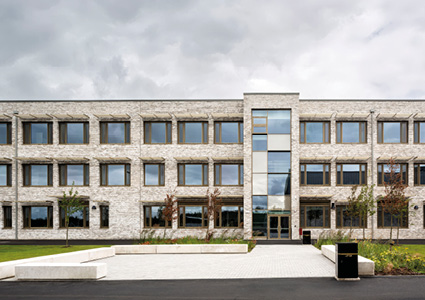
This focus on technology sits alongside Kilmac’s wider investment in preconstruction and project planning. By combining more accurate, real-time site data with the experience of its operational teams, the company can identify buildability, sequencing, and programme challenges earlier, helping to manage risk on complex projects such as the £76 million Clackmannanshire Wellbeing Hub and Lochies School – one of its largest projects to date.
“This project brings together several areas in which Kilmac has developed considerable experience. It has significant Passivhaus requirements, challenging ground conditions and substantial earthworks, while the pool construction introduces another layer of technical complexity,” Athole details. “That has required close collaboration with the main contractor and wider design team around buildability, sequencing and programme. Our Dunfermline operation and established workforce in the area also allow us to service the project locally and competitively. Projects of this scale demonstrate why we have invested so heavily in preconstruction. The earlier our operational experience can influence design and programming, the greater the opportunity to remove risk before it reaches site.
“Another exciting project for Kilmac is our Banchory development, where works have recently commenced on a significant new retail development in Aberdeenshire,” he enthuses. “The scheme represents a major investment in the area, with Home Bargains and Starbucks already signed up to the development, alongside further committed national retailers and an EV charging provider which we expect to announce in the near future. For Kilmac, Banchory is particularly significant because it brings together several strands of experience we have developed over many years. We’ve been involved from the development and preconstruction stages, working through site infrastructure, earthworks, servicing, buildability, and commercial solutions before moving into construction. It demonstrates the value of bringing civil engineering and construction expertise into a development at the earliest possible stage.”
Powerful foundation
For Kilmac, the journey ahead is built on the same foundations that have supported its growth to date, but with an increasing focus on innovation, sustainability, and early involvement. Employee ownership is helping develop the next generation of leadership, while investment in people, technology, and preconstruction is strengthening the company’s ability to deliver increasingly complex projects. As Kilmac continues to expand its presence across Scotland, its combination of technical expertise, local knowledge, and long-term thinking will remain central to its success.
“We want Kilmac to continue going from strength to strength, but our ambitions are broader than a turnover target,” Athole affirms, concluding our conversation. “Geographically, we expect to have consolidated our position throughout Central Scotland while continuing to support and strengthen the Tier 1 relationships that have been fundamental to our growth. We also see an opportunity to undertake a limited number of smaller developments and direct projects where Kilmac’s civil engineering expertise can genuinely add value. In particular, there are brownfield and difficult development sites where abnormal ground and infrastructure costs can prevent otherwise viable projects progressing.
“Perhaps the most exciting aspect of Kilmac today is that the business is increasingly being shaped by the people who will lead it in the future. Employee ownership was never intended simply to be a change in shareholding. It was intended to provide continuity while giving the next generation an opportunity to take responsibility for the business. Ultimately, employee ownership means that when Kilmac succeeds, the people who helped create that success have a stake in its future. That is a very powerful foundation on which to build the next chapter of the company.”