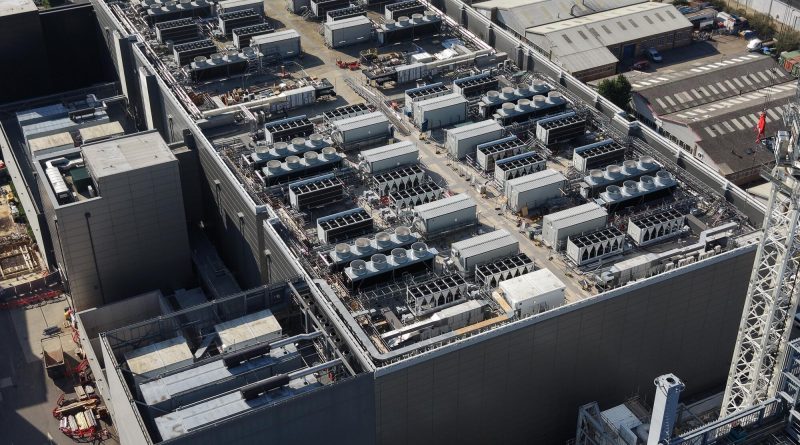
Microsoft pulls out of Essex AI data centre over power concerns
Subscribe to our free newsletter today to keep up to date with the latest construction and civil engineering news.
Microsoft has withdrawn from a major AI data centre project in Essex amid concerns over electricity supply, raising questions about whether the UK’s power infrastructure can support its growing artificial intelligence ambitions.
The technology company has ended its agreement with British AI infrastructure provider Nscale for computing capacity at a planned facility in Loughton. The development was previously promoted by the UK government as an important step towards expanding domestic AI computing capacity.
However, UK Power Networks reportedly informed Nscale that sufficient electricity would not be available until the early to mid-2030s, several years later than the project’s planned opening in 2027.
The withdrawal is a setback for Nscale, which had expected Microsoft to become the facility’s main customer. Nscale maintains that the development will proceed and is exploring alternative power sources.
The decision also raises wider concerns about the capacity of Britain’s electricity network to meet rising demand from AI data centres.
Grid delays are becoming a major obstacle to AI investment
The Essex development illustrates a growing problem for data centre operators. Investment in AI computing is rising rapidly, but the electricity infrastructure needed to support it can take years to develop.
Nscale’s proposed Loughton facility was expected to provide Microsoft with around 50 megawatts (MW) of power capacity, supporting plans to install approximately 23,000 Nvidia chips. The project formed part of a broader effort to strengthen the UK’s domestic AI capabilities.
However, the reported delay in connecting the site to the electricity grid has raised questions about its commercial future.
For data centre operators, access to electricity is one of the most important factors in selecting a site. Large facilities require substantial amounts of power to operate processors, cooling equipment and other systems. They also need a reliable supply around the clock.
As a result, delays in obtaining grid connections can postpone entire projects, even when investors, customers and computing equipment are available.
The scale of the problem is becoming clearer across Britain.
In July 2026, energy regulator Ofgem reported that electricity demand connection applications had increased from 41 gigawatts (GW) to 125 GW in less than a year. Data centre projects accounted for at least 80 GW of this demand, with around 73 GW referenced in the regulator’s consultation on connection reforms.
These figures represent requests for future electricity connections rather than power currently being consumed. They also include projects that may never be built.
Ofgem has proposed commitment fees and stricter project milestones to discourage speculative applications and prevent inactive developments from occupying positions in the connection queue.
These measures could help viable projects gain access to the grid sooner. However, they cannot immediately resolve the physical limits of the electricity network.
Grid upgrades, new substations and additional transmission capacity require years of planning and investment. For developers seeking to begin operations within two or three years, those delays can create significant financial risks.
Rising electricity demand is changing data centre economics
The challenges facing the Essex development reflect a wider increase in global electricity demand from data centres.
According to the International Energy Agency (IEA), global data centre electricity consumption is projected to increase from 485 terawatt-hours (TWh) in 2025 to around 950 TWh by 2030.
This would represent approximately 3% of worldwide electricity consumption by the end of the decade. Demand from facilities designed specifically for AI is expected to grow even faster, potentially tripling over the same period.
These projections show the scale of the challenge facing electricity networks, particularly in areas where several large data centres are planned.
AI computing systems require substantial amounts of electricity because they use large groups of high-performance processors. These systems also generate considerable heat, increasing the need for cooling.
Although improvements in hardware and software are reducing the energy required for individual AI tasks, growth in overall computing demand is expected to outweigh many of these efficiency gains.
For developers, securing electricity capacity is becoming as important as obtaining land, planning permission or financing.
A project that cannot access sufficient power on schedule may face higher financing costs, delayed customer contracts and uncertainty over its expected returns.
These concerns are especially relevant to specialist AI cloud providers, which are investing heavily in new facilities to meet expected demand from technology companies.
Many rely on large customer agreements to support their expansion plans. Delays that prevent a facility from becoming operational can therefore place additional pressure on investment schedules and financing arrangements.
One possible response is to generate electricity directly at data centre sites.
Nscale has confirmed that it is considering alternative power sources for its Loughton development, alongside other possible UK locations.
On-site generation could reduce dependence on conventional grid connections. However, developers would still need to consider fuel supplies, emissions, planning requirements and the cost of maintaining a reliable electricity supply.
These decisions could have lasting effects on the financial and environmental performance of AI infrastructure.
The UK’s AI ambitions depend on faster power infrastructure
Microsoft’s withdrawal comes as the UK seeks to attract more private investment in AI infrastructure and expand its domestic computing capacity.
The government has identified data centres as an important part of its economic and technology strategy, with major developments expected to support employment, construction activity and demand for related services.
However, investment announcements do not always result in operational facilities.
The Loughton project shows the difference between securing commercial support for a development and delivering the infrastructure needed to operate it.
For policymakers, the challenge is to ensure that electricity network investment keeps pace with demand without placing unnecessary costs on households and other businesses.
Grid connection reform is part of that process, but closer coordination between technology companies, electricity networks and government agencies may also be needed.
Identifying suitable locations earlier, assessing electricity requirements before projects are announced and improving the accuracy of connection schedules could help developers make better investment decisions.
There is also the question of where future AI data centres should be located.
Areas with limited grid capacity may become less attractive, even when they offer access to large markets, skilled workers and established telecommunications networks.
By comparison, sites with available electricity infrastructure or access to new power generation could become more attractive to investors.
This may influence how future investment is distributed across the UK, particularly as competition for grid capacity increases.
The implications extend beyond technology companies. Engineering firms, electricity network operators, power equipment manufacturers and energy developers could see greater demand for infrastructure that supports large computing facilities.
However, those opportunities depend on projects progressing beyond the planning stage.
Nscale has said it remains committed to the Essex development and that its other agreements with Microsoft are unaffected. The company is examining options to address the site’s power supply problems while considering further expansion elsewhere in the UK.
For the wider industry, the case illustrates the growing importance of electricity infrastructure in AI investment decisions.
Building computing facilities is only one part of the challenge. Their commercial success also depends on securing enough reliable electricity at a cost and within a timeframe that makes the investment viable.
As demand for AI computing increases, the ability to deliver electricity infrastructure on schedule could play a greater role in deciding where new data centres are built and which projects proceed.
Source:
The Guardian