New refurbishment opportunities, sustainability progress, and AI adoption define Century Facades evolving strategy
Century Facades Ltd (Century) is one of the UK’s most technically competent combined facade engineering and building facade contractors. Its directors and senior management team bring over 200 years’ combined experience delivering high-specification building envelope projects. Formed in 2012, the company continues to deliver a client- and cost-focused approach to facade design, engineering, and installation.
“Since we last spoke around a year ago, the business has continued to evolve strategically, particularly in how we position ourselves within the sector and the wider construction market,” begins Tim Lovell, Managing Director.
“One of the most significant developments has been our expansion into new sectors, particularly the London office refurbishment and repositioning market. Historically, a large proportion of our order book was driven by high-rise developments, but with delays linked to the Building Safety Regulator, we made a conscious decision to de-risk the business and broaden our exposure across other areas of the market.
“These are sectors we already understood technically but hadn’t previously traded in at scale. That strategic shift has allowed us to reposition ourselves successfully, and we’ve since secured key London office refurbishment projects.
“There is a strong push across the sector toward upgrading existing commercial assets to meet modern workplace expectations, sustainability targets, and improved energy performance standards. As a leading facade contractor, this plays directly to our strengths, particularly where schemes involve complex facade replacement, over-cladding, and building envelope enhancement delivered in constrained live environments.
“These projects also bring multiple layers of complexity. Working with existing structures while introducing entirely new facade systems requires a high level of detailed design coordination. At the same time, because these buildings are in London, there is still a strong architectural ambition to create visually striking developments, which adds further technical and aesthetic challenges to the facade design and delivery process.”
Sustainability has become an increasingly important driver of both client decision-making and Century’s internal strategy. A key focus is reducing embodied carbon within facade design and delivery. This includes working closely with clients, consultants, and supply-chain partners to optimise material selection, increase opportunities for reuse and retention where feasible, improve manufacturing efficiency, and develop facade solutions that reduce whole-life carbon impact while maintaining demanding aesthetic and performance requirements.
“We recognise that we have a responsibility to help protect the future,” says Tim. “A major opportunity lies in increasing the use of recycled materials, particularly aluminium.
“As a business, we made a commitment to achieve Net Zero by 2030, and we recognised early on that this couldn’t be achieved in isolation. It requires full buy-in across the supply chain. We’ve worked closely with our partners to understand not only what we can improve internally, but also what they are doing in terms of their own decarbonisation journeys and Scope 3 commitments.
“We don’t just want to meet expectations; we want to exceed them. Sustainability is now central to how we position ourselves in the market. By prioritising lower-carbon materials and smarter procurement decisions, we are helping clients reduce the embodied carbon associated with their projects.
“We’re already seeing real progress in this area. Across the aluminium we procure for our systemised facade products, between 75 and 80 per cent now comes from recycled content, and we are achieving similar levels within our pressed metalwork products, which form a significant part of our output.
“The same thinking applies to glass. We actively work with manufacturers who can provide recycled-content glass solutions, ensuring sustainability is considered across the entire building envelope. Within the office refurbishment and repositioning market, we also place strong emphasis on recycling and repurposing materials removed from existing facades wherever possible.
Enhancing existing expertise
“When you look at the wider picture, refurbishment schemes typically deliver a lower embodied carbon impact compared to full redevelopment. That is a significant advantage and one of the reasons we believe this part of the market will continue to grow.”
The company has also invested in digital capability, particularly the use of AI-supported tools across design, manufacturing, and installation processes. These systems are being used to identify clashes, compliance risks, tolerancing issues, and installation challenges earlier in the process, improving coordination, reducing rework, and enhancing overall quality and consistency.
“Importantly, we see AI very much as a support function for our engineers and wider teams, rather than a replacement,” Tim explains. “It enhances the expertise already within the business and gives our teams better tools to work more effectively.
“What AI is really helping us achieve is greater accuracy, precision, and efficiency across multiple areas. Whether that is improved coordination, earlier issue detection, or enhanced quality assurance, these tools allow us to deliver work with a higher level of consistency.
“In the current environment of rising costs and commercial pressures, it also helps us work smarter and reduce unnecessary overheads. But people remain our biggest asset, and that is not changing. AI is about enabling teams, not replacing them, and allowing people to focus on higher-value tasks.
“One of the most important areas where we are seeing benefits is quality assurance and project traceability. From project inception through to final handover, we want a complete digital record of all works undertaken. That level of traceability is becoming increasingly important, particularly if defects or performance issues arise later in a building’s lifecycle.
“These platforms can also identify potential faults, inconsistencies, or installation risks earlier in the process, allowing teams to intervene sooner, improve quality control, and reduce the likelihood of rework. Across the industry, robust traceability is becoming essential.”
Investing in operations
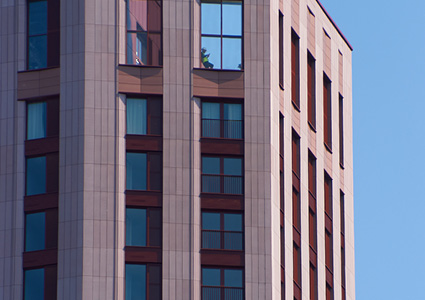
One project Century is particularly proud of over the last year is the Enclave development in Acton for Tide Construction. The 33-storey co-living scheme was delivered within an 18-month programme and provides 462 homes alongside approximately 1500 square metres of commercial space. From a facade perspective, the project was both ambitious and technically demanding.
A key feature is its multifaceted facade design, incorporating natural terracotta finishes, projecting oriel bays, and high-performance aluminium window systems. The geometry and materiality added significant complexity to the engineering, coordination, and installation process.
Delivering the project required close collaboration across design, manufacturing, supply chain, and site operations. Enclave reflects the direction of the modern facade sector, combining architectural ambition, programme efficiency, modern methods of construction, and high-performance building envelope solutions within dense urban developments.
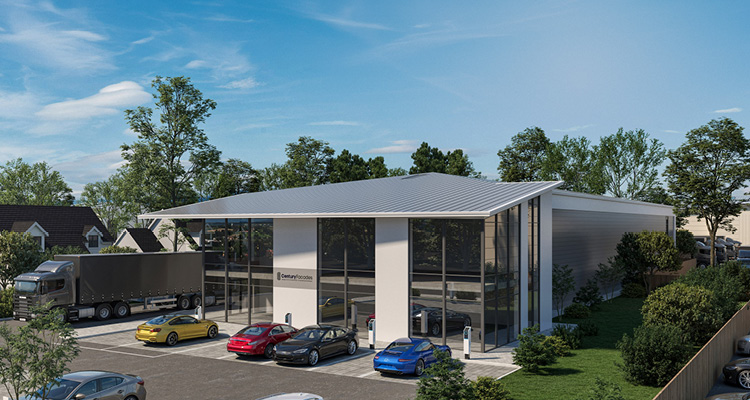
Likewise, the construction of Century’s new factory is progressing well and represents a significant investment in the future capability of the business. Groundworks have now been completed, with foundation piling scheduled to commence in summer 2026.
The facility has been designed to strengthen both distribution and off-site storage capacity, while also enhancing quality assurance processes through expanded inspection and testing capabilities.
“The new facility will allow us to undertake far more detailed quality checks on fabricated facade components before they leave the factory,” Tim elaborates. “That improves consistency, reduces installation risk, and gives our clients greater programme certainty. Sustainability has also been embedded into the design, with a focus on energy efficiency, lower-carbon manufacturing, and improved operational performance.”
Foundations for the future
Century currently has five projects scheduled to commence on site during 2026 and 2027, providing a strong pipeline of secured work and excellent forward visibility for the business.
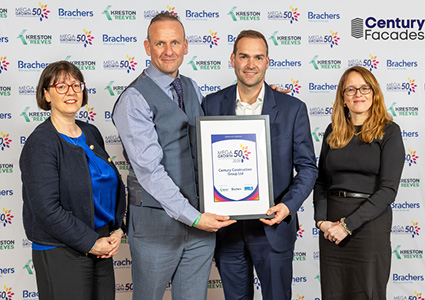
“We have been delighted to be recognised as one of the fastest-growing companies in Kent through inclusion in the Mega Growth 50,” Tim shares. “This recognition reflects the hard work and commitment of our entire team, as well as the strength of the relationships we have built with clients, consultants, and supply chain partners. It is particularly rewarding given the wider changes taking place across the construction and facade sectors.
“For us, this achievement is not just about growth in turnover; it is about building a sustainable business with strong foundations for the future. That means continued investment in people, technology, manufacturing capability, and long-term client partnerships.
“I see us as a trusted partner and a leading UK designer, supplier, and manufacturer of facade components,” Tim concludes. “With a strong team and modern facilities, we are well positioned to continue operating at Tier 1 level and to build on that reputation in the years ahead.”