Oranmore Precast is combining experience, technology, and investment to push its capabilities further across the UK
With two strategically located, state-of-the-art facilities in Brandon and Lound, Oranmore Precast has established itself as one of the UK’s largest precast manufacturers, with the capacity to produce around 10,000 square metres of hollowcore flooring each week.
Its approach combines decades of precast experience with the advantages of modern offsite manufacturing. By bringing design, engineering, and production into a controlled factory environment, Oranmore helps contractors deliver projects with greater efficiency while reducing site labour and construction time. Alongside its core hollowcore, beam and block, and stair products, the company also specialises in bespoke precast solutions, creating tailored components for complex and high-profile projects across the UK.
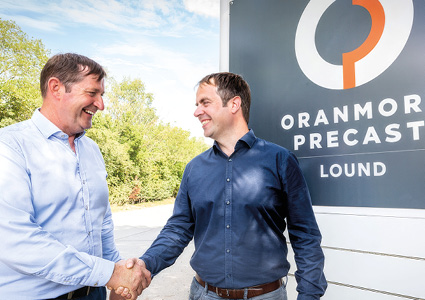
“Oranmore was founded in November 2011 by me and Richard Burke,” begins Ross Melville, Managing Director. “Richard and I both came from backgrounds in precasting in Ireland, and when the opportunity arose to take on the Brandon site, we took it. That was the genesis of Oranmore.
“From the outset, we wanted to be a full-service precast company, bringing early engagement, design, detailing, and manufacturing together under one roof. That was the model we had come from, and we saw an opportunity to bring that approach to the UK market. Rather than simply manufacturing precast products and outsourcing elements such as design and detailing, we could provide a more joined-up service.
“We’ve always pushed for early engagement with our customers. It’s something that’s become a bit of a buzzword now, but with precasting, the earlier you engage, the more opportunities there are to identify savings and give the customer greater foresight over the project.”
Expanding across key sectors
Oranmore works across multiple sectors, from hospitals and multi-storey car parks to high-rise buildings. The company also works on projects for the Ministry of Defence and Ministry of Justice that, understandably, don’t make the headlines.
“We’ve developed a high-rise precast delivery system in conjunction with Mace that can be used on buildings of up to 40 storeys,” Ross shares. “Our original offering was hollowcore flooring, but we’ve continued to expand our capabilities. With the addition of our Twinwall plant, we’ve been able to bring even more of the products required for our projects into our own manufacturing capability.
“We provide the full service, from design and manufacturing through to contract management, logistics, and installation, but we’re very flexible in how customers use us. Some will take the complete package, while others may handle elements such as installation themselves. That flexibility, combined with the breadth of sectors we work across, allows us to adapt as market conditions change.”
When Richard and Ross were working in precast in Ireland, they were involved in bringing Twinwall into the business back in 2005, so had a lot of experience with the product.
“We always had it in the back of our minds that there was an opportunity to introduce that capability to the UK, particularly because so much Twinwall was being supplied from Belgium and Ireland,” Ross adds. “There wasn’t an independent UK producer, so we saw a clear gap in the market.”
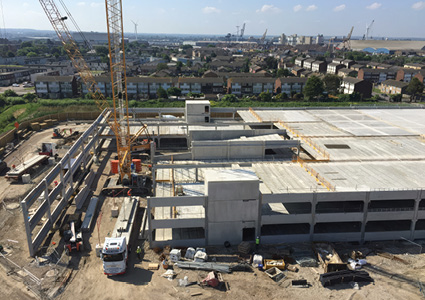
Establishing the Twinwall plant at Lound has been a significant project over the past 24 months, involving major infrastructure upgrades and a lot of work to select the right suppliers and bring everything together. The plant is now complete and operational, and it has been busy from the outset, with strong interest from Tier 1 contractors.
“Having a UK-based supply also makes a lot of sense from a carbon and supply-chain perspective. It doesn’t make sense to transport precast concrete from Belgium or Ireland when it can be manufactured much closer to the project. We’ve experienced the challenges of overseas supply first-hand, with shipments delayed by weather and even low tides affecting the movement of trailers. Producing Twinwall domestically gives customers a more resilient and reliable supply chain.
“The plant is also at the cutting edge of precast manufacturing, with greater use of robotics in areas such as steel placement and concrete production. That is helping to reduce the workload on our teams, increase efficiency and, importantly, reduce waste.”
High-rise innovation
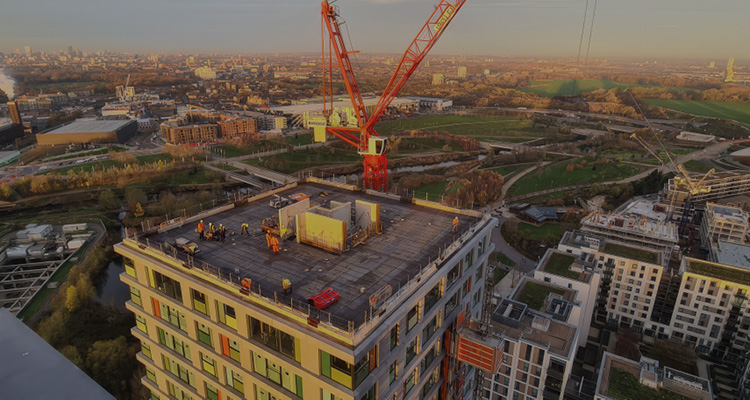
A standout example of Oranmore’s capabilities is its work on Chapter Living, a 39-storey, 138-metre student accommodation tower in London comprising 905 beds and 15,000 square feet of amenity space. Working alongside Mace and its High-Rise Solutions (HRS) system, Oranmore supplied the precast concrete elements from its Brandon facility. The approach combines offsite manufacturing with digital technology to support faster construction, reduced waste, and improved efficiency.
The project presented a particularly demanding construction environment, with the building occupying virtually the entire footprint of the site. Oranmore’s contribution formed part of a system that enabled the concrete floor and aluminium façade to be installed simultaneously, with the façade bolted directly to the precast element before being erected as a single unit. The tight brownfield site, located beside a railway station, required an innovative approach to logistics and lifting, with the tower crane bases even extending onto the road. For Oranmore, the project demonstrates how its precast expertise can help overcome the practical constraints of high-rise construction while supporting a more efficient delivery model.
“A lot of our R&D is customer-centric,” Ross elaborates. “Customers come to us with a problem or a general idea of what they want to achieve, and we work with them to develop a solution. The HRS system with Mace is a good example of that. They came to us with an idea and asked whether we could deliver it. We brought together people from across the business, including our directors, engineering and manufacturing teams, as well as colleagues on site, to work through the challenge collectively.
“That collaboration is important because you can develop a solution that works brilliantly from a manufacturing perspective but creates difficulties on site, or vice versa. We bring all those stakeholders into the process to make sure the solution works across the whole project. It’s an extension of our approach to early engagement, whether that’s on an individual project or working with a customer over a series of projects to develop a system that meets their needs. It’s very much a collaborative process.
“Although we’ve been in business for 15 years, we still see ourselves very much as a young company, and we’re firmly in a growth phase. You only have to look at the scale of our sites and the investment we’ve made over the last five years to see that. Taking on Lound was a significant step, and the investment in the Twinwall plant has been another major milestone, but it certainly won’t be the last.
“We have a lot of R&D activity underway, and if some of those projects come to fruition, they could create a substantial requirement for additional space and production capacity. That could mean expanding our existing facilities, taking on a third site, or potentially doing both,” Ross concludes. “We’re continuing to look at where the next opportunities are and how we can build on the platform we’ve created.”