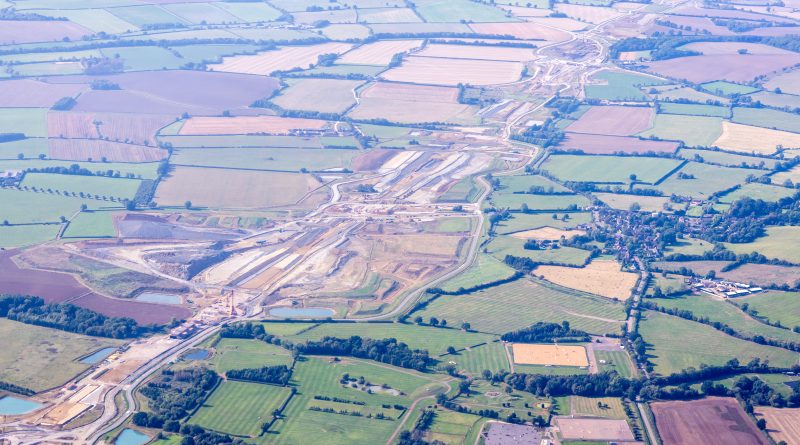
The £856m project that could redefine HS2’s future
Subscribe to our free newsletter today to keep up to date with the latest construction and civil engineering news.
HS2 has awarded an £856m contract for the development of the Washwood Heath depot and Network Integrated Control Centre in Birmingham, marking one of the most operationally significant investments in the project to date.
The contract, awarded to a joint venture between Taylor Woodrow Infrastructure and Aureos Rail, will transform a former industrial site in east Birmingham into the operational core of Britain’s high-speed rail network. Recent debate around HS2 has largely centred on cost overruns, route changes and political scrutiny, yet the Washwood Heath development reflects a broader shift within the project. HS2 is now moving beyond large-scale civil engineering works and towards the systems, logistics and operational infrastructure required to run a national railway.
For Birmingham, the announcement also carries symbolic weight. Washwood Heath was once synonymous with British rail manufacturing, and the return of major rail investment reconnects the area with a legacy stretching back decades.
The site’s industrial history is shaping its next chapter
The 70-hectare brownfield site has long occupied a central position within Birmingham’s industrial economy. Metro-Cammell, once one of Britain’s best-known train manufacturers, operated from the location before the site later housed LDV vehicle production. Pendolino trains were among the final rolling stock manufactured there before operations ceased in 2005.
That industrial history is now becoming part of HS2’s long-term operational strategy.
The depot will eventually become the primary maintenance and stabling facility for the HS2 fleet. Plans include a Rolling Stock Maintenance Building, carriage washing facilities, stabling sidings, a dedicated test track and an Automatic Vehicle Inspection Building designed to support continuous monitoring and servicing of trains.
Alongside the depot infrastructure, the site will also house the Network Integrated Control Centre, effectively the operational command centre for HS2 services. The facility will oversee train dispatch, infrastructure monitoring and network coordination across the wider route.
In practical terms, Washwood Heath is expected to become one of the most strategically important locations on the HS2 network. Without the systems housed there, the railway itself cannot operate efficiently at scale.
That distinction matters because it reflects a wider transition within HS2. The project is no longer defined solely by tunnels, bridges and station construction. Operational readiness is now becoming equally important.
Why the Washwood Heath hub matters for the future of HS2
The timing of the contract is notable.
HS2 has spent the past two years under sustained political and financial pressure, culminating in the cancellation of the Birmingham-to-Manchester leg and repeated questions surrounding governance, delivery and procurement oversight.
Under chief executive Mark Wild, the organisation has started repositioning itself around tighter delivery controls and operational certainty. The Washwood Heath contract appears closely aligned with that approach.
Unlike some earlier phases of HS2 procurement, the depot development is directly linked to the day-to-day viability of the railway once passenger services begin. Maintenance facilities, control systems and operational resilience may attract less public attention than major stations, yet they remain essential to network reliability.
The project also illustrates how rail infrastructure procurement is evolving across the UK. The appointment of a joint venture combining major infrastructure delivery with specialist rail expertise reflects growing pressure for integrated delivery models capable of managing both construction complexity and operational systems.
For the supply chain, the scale of the project creates opportunities across rail engineering, systems integration, electrical infrastructure and long-term maintenance support. Construction activity alone is expected to support around 500 jobs, while more than 1,000 permanent operational roles could eventually be based at the site.
That employment pipeline may prove especially significant for Birmingham and the wider West Midlands, where advanced manufacturing and engineering skills remain central to regional economic planning.
What the project could mean for Birmingham and the West Midlands
Beyond rail operations, the Washwood Heath development is increasingly being positioned as part of a wider regeneration strategy for east Birmingham.
Large-scale transport projects have historically struggled to translate infrastructure spending into local economic transformation. HS2 leadership has repeatedly argued that the railway’s long-term value will depend partly on whether surrounding areas can attract investment, commercial development and skilled employment.
Washwood Heath presents one of the clearest tests of that argument.
The site sits within a broader corridor of regeneration activity linked to Birmingham Curzon Street station, advanced manufacturing investment and transport connectivity improvements across the region. HS2 estimates the wider project could contribute around £10bn to the West Midlands economy over the next decade, although the scale of that impact will depend heavily on delivery timelines and private sector confidence.
There is also a symbolic dimension to the redevelopment. Reintroducing rail operations to a site once associated with British train manufacturing reinforces a narrative centred on industrial continuity rather than replacement. In a city where manufacturing identity still shapes economic policy and political messaging, that carries significance.
The challenge now will be execution.
The Washwood Heath contract arrives at a moment when HS2 is attempting to rebuild confidence across government, industry and the public. Delivering a functioning operational hub on time and under tighter financial scrutiny could become an important benchmark for whether the project’s revised approach is succeeding.
For Birmingham, the stakes extend beyond HS2 itself. The redevelopment of Washwood Heath will help determine whether major infrastructure investment can still act as a catalyst for long-term industrial renewal in modern Britain.
Source