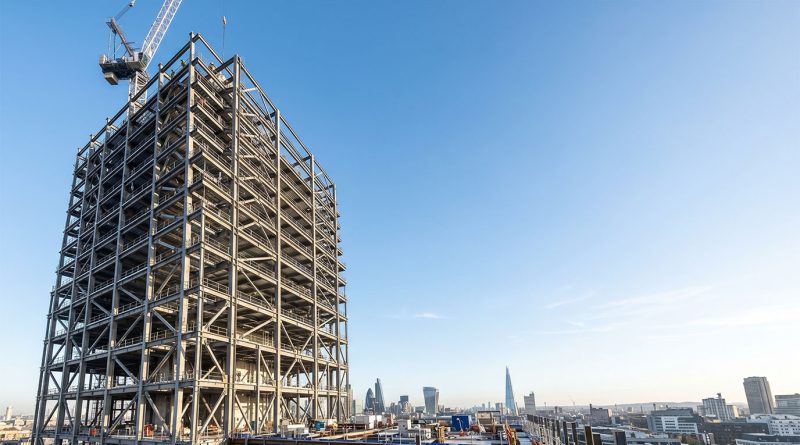
What London’s next skyscraper race reveals about the future of urban development
Subscribe to our free newsletter today to keep up to date with the latest construction and civil engineering news.
From the Gherkin and the Shard to the City of London’s growing cluster of towers, each new addition has signalled changing priorities in finance, commerce and urban planning. Now, proposals for what could become Western Europe’s joint tallest tower suggest the capital’s appetite for landmark developments remains strong despite ongoing economic uncertainty.
Plans unveiled for the development would create a building matching the height of the Shard, reshaping part of the capital’s skyline while adding significant office, residential and public space. Although the proposal remains subject to planning approval, it has already generated discussion about the role of large scale developments in a city facing competing pressures around housing, sustainability and economic growth.
For business leaders and investors, the significance extends beyond architecture. The project offers insight into how developers are responding to changing market conditions and what the next generation of urban development may look like in one of the world’s most competitive real estate markets.
The race to redefine London’s skyline
Tall buildings have always served a purpose beyond their physical dimensions.
For developers, they maximise the value of scarce urban land. For cities, they often become symbols of confidence and economic ambition. For occupiers, they can provide access to modern, highly efficient space in locations where demand continues to exceed supply.
The latest proposal arrives at a time when the future of office development remains the subject of intense debate. Hybrid working has altered demand patterns across many markets, prompting questions about how much office space businesses will require in the years ahead.
Yet while some older buildings have struggled to attract tenants, demand for premium office space remains relatively resilient. Occupiers are increasingly seeking high quality buildings that offer strong environmental credentials, advanced technology and amenities capable of attracting employees back into city centres.
Developers appear to be responding accordingly. Rather than reducing ambition, many are focusing on creating larger, more sophisticated developments designed to meet evolving workplace expectations.
The proposed tower reflects that trend. Beyond its height, the scheme aims to deliver a mix of commercial and public uses that align with broader planning objectives around sustainability, connectivity and urban regeneration.
In that sense, the project is as much about future proofing as it is about breaking records.
Why developers are still thinking big
The scale of the proposal may surprise some observers given the challenges currently facing the real estate sector.
Higher borrowing costs, construction inflation and economic uncertainty have created a more difficult environment for developers across Europe. Financing large projects has become increasingly complex, while investors are paying closer attention to risk and long term returns.
Despite these headwinds, major cities continue to attract investment. London remains one of the world’s leading financial centres and continues to benefit from strong international interest in commercial real estate.
Developers recognise that prime locations are finite. Securing opportunities in established business districts often requires projects that maximise both density and long term value.
At the same time, planning policies are placing greater emphasis on sustainability. Modern towers are increasingly expected to achieve high environmental standards while supporting wider urban goals such as improved public spaces, active transport and reduced carbon emissions.
These expectations are influencing design decisions from the earliest stages of development. As a result, many new projects combine commercial objectives with broader social and environmental considerations.
The proposed tower highlights how developers are attempting to balance these priorities while creating assets capable of remaining competitive for decades.
What it means for the future of city development
The debate surrounding skyscrapers often centres on aesthetics, but the wider implications are economic.
Large developments generate significant employment throughout the construction process and can support thousands of jobs once operational. They also contribute to local supply chains, attract investment and help reinforce the status of major business districts.
For London, maintaining that competitiveness remains an important objective. Cities across Europe, North America and Asia continue to compete for investment, talent and corporate occupiers. The quality of the built environment increasingly forms part of that competition.
Projects such as this also illustrate how urban development is evolving. The next generation of landmark buildings is expected to deliver more than office space alone. Investors, planners and occupiers increasingly want mixed use environments that combine work, leisure, retail and public amenities within a single destination.
That shift reflects broader changes in how people interact with cities. Successful developments are increasingly judged on their ability to create vibrant, connected places rather than simply maximising floor space.
Whether the latest proposal ultimately receives approval remains to be seen. Planning processes, market conditions and public consultation will all influence the outcome.
What is already clear, however, is that London’s skyline remains a reflection of its economic ambitions. Even in a period of uncertainty, developers continue to think on a grand scale.
Sources