
Why housing developments suddenly stall: the financial triggers behind paused sites
Dane Westwood, performance bond specialist at CG Bonds, a surety bond specialist brokerage providing bonds to the construction sector, examines the financial pressures causing housing developments to stall and the growing impact on contractors, developers, and supply chains across the sector.
Pressure building across housing delivery
Across the UK, housing developments are increasingly slowing mid-phase, pausing unexpectedly, or stopping altogether. Although planning delays often dominate the conversation, many stalled sites are actually the result of financial pressure building gradually across live projects.

The wider housing market is already under strain. ONS data shows just 175,290 homes were completed in England over the first 15 months of the current government, well below the 300,000 per year target. Based on current trends, completions could fall to around 130,000 this year, the lowest level since 2014, while housing starts continue to weaken.
At the same time, pressure across the construction industry itself remains intense. In the 12 months to June 2025, nearly 4000 construction companies collapsed, accounting for 17 per cent of all corporate insolvencies, more than any other sector.
For contractors and developers, stalled projects are rarely caused by one isolated issue. More commonly, weaker buyer demand, rising construction costs, tighter funding conditions, delayed affordable housing agreements, and supply chain instability all begin affecting a project at the same time.
Why live developments become vulnerable
Housing developments rely heavily on phased delivery, projected sales, and stable cash flow. Developers are often balancing land costs, planning obligations, finance agreements, contractor payments, and delivery targets simultaneously, leaving little flexibility once market conditions begin to shift.
Higher interest rates have reduced buyer confidence and slowed transaction levels across many regions. Although headline house prices have only fallen modestly since 2022, sales activity has weakened far more sharply, affecting the pace at which capital returns into developments.
Many developers are increasingly relying on buyer incentives to maintain sales while protecting headline pricing. While this can help preserve valuations and market confidence, slower transactions and delayed completions still place pressure on phased developments that depend on future sales and lender drawdowns to support later stages of construction.
At the same time, build costs remain elevated compared with pre-pandemic levels. Labour costs continue rising, materials remain volatile, and contractors operating under fixed-price agreements are facing growing pressure where fluctuation clauses are absent.
Cash flow pressure across the supply chain
With contractors often funding labour, materials, plant, and subcontractors long before payment is received, construction remains especially vulnerable to cash flow disruption. Delayed payments, retentions, rising labour costs, and tighter lender scrutiny are all adding pressure to projects already operating with limited financial flexibility.
When financial strain begins affecting one part of the supply chain, the wider impact can spread quickly across a live development. Suppliers may tighten credit terms, subcontractors may reduce labour activity, and developers can face delays while replacement contractors are sourced or revised pricing is negotiated.
On phased housing schemes, where future delivery targets are closely tied to construction progress and funding milestones, even relatively short disruptions can affect momentum across the wider site.
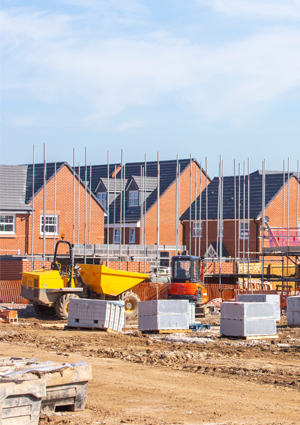
In many cases, warning signs begin appearing long before activity stops completely. Reduced labour presence, fewer deliveries, delayed valuations, and changing payment behaviour can all indicate growing financial pressure behind the scenes, particularly as insolvency levels across the construction sector remain elevated.
Section 106 delays affecting build-out rates
Section 106 affordable housing agreements are becoming another growing pressure point across housing delivery. Around 700 housing developments have reportedly been affected by delays linked to Section 106 affordable housing, while approximately 8500 affordable homes due for delivery within the next year are now considered at risk.
Many developments rely on Registered Providers purchasing affordable units to maintain cash flow and support future construction phases. When housing associations pull back from acquisitions because of funding pressure or retrofit liabilities, progress across the wider scheme can begin slowing.
The impact extends well beyond affordable housing itself. More than 100,000 private homes were reportedly caught within wider delays linked to stalled Section 106 agreements last year, creating further uncertainty for contractors, suppliers, and developers working across phased sites.
For SME housebuilders especially, this creates substantial commercial risk, as future construction activity is often dependent on phased sales and completions.
Rising compliance costs and weaker viability
Alongside wider economic pressure, developers are also facing rising costs linked to fire safety requirements, Biodiversity Net Gain obligations, environmental mitigation measures, and new building safety processes.
In some areas, rising construction costs and weaker sales values are making developments increasingly difficult to deliver profitably. Even where planning permission is already secured, some projects are becoming financially unviable before later phases can begin.
As a result, more approved developments are slowing after consent rather than before it.
Financial resilience is becoming increasingly important
The UK’s housing shortage remains substantial, but stalled developments show that delivery depends on far more than planning permission alone.
Higher interest rates, weaker buyer demand, contractor insolvencies, labour shortages, compliance costs, and delayed affordable housing agreements are all combining to place growing pressure on live housing projects.
For the construction sector, maintaining delivery will depend as much on financial resilience and project assurance as planning reform or housing targets. As pressure across the market continues to build, developers, contractors, lenders, and supply chains are placing greater focus on contractor stability, risk mitigation, and protecting project continuity across live developments.
Dane Westwood
www.cgbonds.co.uk
CG Bonds is a bond broker, specialising in the procurement of safety bonds. A specialish surety bond broker, the company can source and secure the best value construction bonds in the market, whilst using years of unruvalled experience to make it a stress-free and simple process.